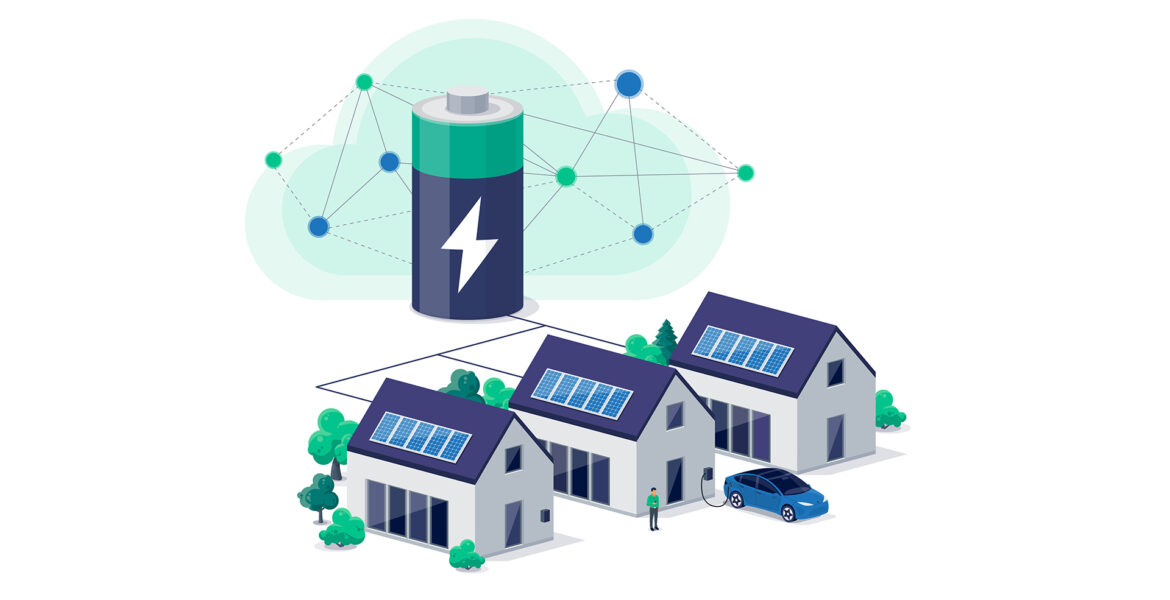
A virtual power plant, or VPP, is a network of distributed energy resources-commonly household solar and battery systems-that are coordinated through software so they can respond collectively to electricity-market or grid conditions.
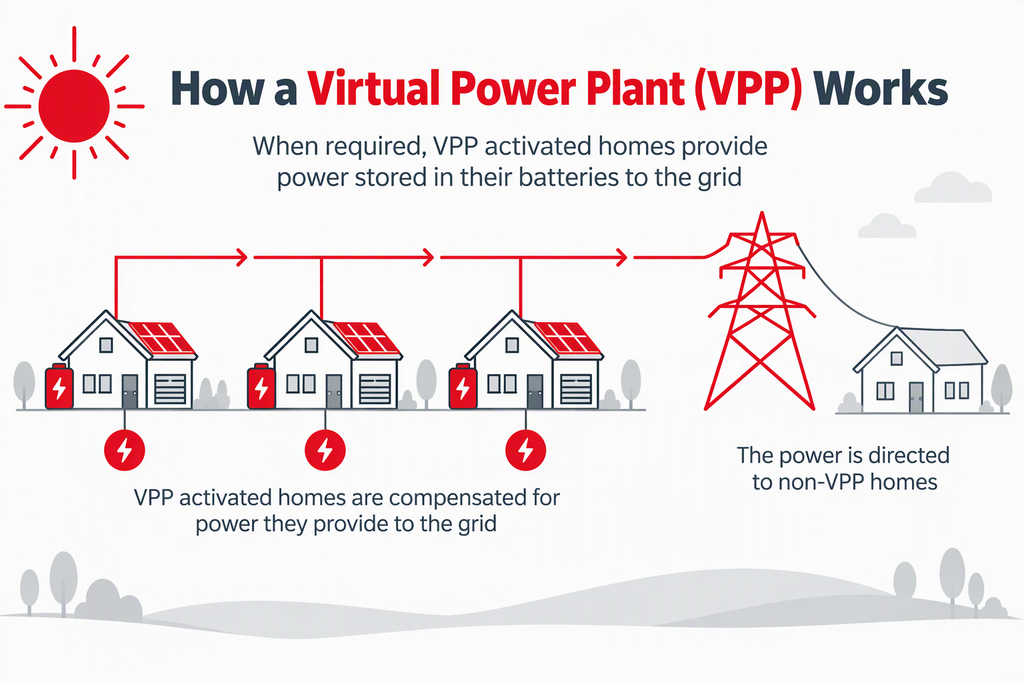
For a household, joining a VPP usually means agreeing to let an operator interact with an eligible battery under defined program rules. Depending on the agreement, that may involve charging or discharging the battery at particular times or exporting stored electricity to the grid.
The key question is not simply whether a VPP offers a payment or credit. It is whether the control, value, backup implications and contract terms suit your household.
How does a household battery participate in a VPP?
A VPP needs more than a battery. Participation can depend on the battery, inverter, communications connection, software or firmware, metering, electricity retailer, geographic location and the provider operating the program.
Three different concepts matter:
- VPP-capable: the equipment has the technical ability required to communicate and respond to relevant remote signals.
- Program-compatible: the exact equipment and configuration are supported by a particular VPP provider or scheme.
- Enrolled: the household has actually entered the VPP agreement and is contractually participating.
These are not interchangeable.
That distinction is especially important in Australia. Under the federal Cheaper Home Batteries Program, eligible on-grid battery systems generally need VPP capability, but the capability requirement itself does not require the household to join a VPP. Western Australia’s current battery scheme works differently: qualifying rebate and eligible-loan participants must enter an eligible VPP arrangement. NSW has a separate current incentive for connecting an eligible battery to a participating VPP.
If you are still choosing your storage system rather than deciding whether to enrol it in a VPP, see choosing the right solar battery.
Who controls what?
A VPP can involve several parties, and their roles should not be blurred.
| Participant | Typical role | What you as homeowner should check |
|---|---|---|
| Homeowner | Owns or uses the system and agrees to the VPP terms | What control remains with you and what obligations apply |
| Solar system | Generates electricity | Whether the system architecture is compatible |
| Solar battery | Stores electricity for household use or export | Exact model compatibility, applicable reserve rules and warranty conditions |
| Inverter and energy-management equipment | Coordinates power conversion and system behavior | Whether the exact model, software and configuration are supported |
| Communications platform (like Fronius solar.web) | Carries operating data and control signals | Internet requirements, data handling and what happens if communications fail |
| VPP operator or aggregator | Coordinates participating systems | Remote-control permissions, event rules and payment arrangements |
| Electricity retailer | May provide the VPP tariff or retail contract | Whether changing retailer or plan is required |
| Equipment manufacturer | Provides product support and warranty terms | Whether the proposed VPP use is compatible with applicable warranty conditions |
What happens during a VPP event?
A household has solar, an eligible battery and a system configured for blackout backup. On a high-demand afternoon, the VPP operator sends a dispatch instruction permitted by the customer’s agreement. The battery exports some stored electricity to the grid.
The household continues to use electricity afterwards. Later, a grid outage begins.
The energy then available for backup depends on the battery’s actual state of charge, subsequent household use, system configuration and any reserve rules applying under the VPP agreement.
Participation therefore does not automatically remove blackout backup. But it also does not guarantee that the battery will contain the amount of stored energy the household would have chosen when an outage begins.
What are the potential benefits and trade-offs?
| Potential benefit | Trade-off or question to investigate |
|---|---|
| Upfront incentive, credit or participation payment | What conditions must be met to receive and keep it? |
| Additional value from stored electricity | How is compensation calculated? |
| Participation in grid or market services | How much battery-control authority does the operator receive? |
| Program-controlled charging or discharging | What exactly does the contract allow? |
| A program may provide household reserve options | Does this specific program publish a reserve feature, and who controls it? |
| VPP participation may improve battery economics for some households | Does the total offer still work after tariffs, contract conditions and battery use are considered? |
A headline payment is only one part of the value equation. NSW Government guidance, for example, advises customers to compare VPP providers because actual incentives, electricity prices and battery-access arrangements can differ.
For the broader storage decision, see whether a home battery is worth it.
Battery backup, cycling and warranties: what should you check?
If backup matters to you, ensure your system provides backup power. A battery does not automatically make a grid-connected home capable of operating during an outage.
Then check the VPP agreement carefully.
Consider reserve setting, customer override, event limit and grid charging features only when the relevant program documents them. If the contract is silent, ask the provider rather than assuming the feature exists.
A useful decision path is:
Does the battery system provide blackout backup and, if so, does the VPP explain how it reserves battery energy for household use?
Joining a VPP will not add blackout backup to a system that does not already provide it. Where a VPP publishes battery reserve settings, check who can change them and under what circumstances. Otherwise, do not assume a fixed amount of stored energy will remain available.
Could VPP activity change the battery’s charge before an outage?
If the agreement allows battery dispatch, the state of charge when an outage begins may differ from what it would otherwise have been.
VPP participation may also change charging and discharging patterns. That does not mean participation automatically damages a battery. Consider any additional battery use when evaluating the system.
Before joining, check the exact battery warranty, including any throughput, operating or VPP-related conditions, and understand whether a provider offers any additional protection. Do not treat a warranty as evidence that VPP participation has no effect on battery use or life.
How should you compare payments and total household value?
VPP compensation can take different forms, including upfront incentives, bill credits, recurring payments, event-based payments and special electricity tariffs.
Compare the whole arrangement:
| Factor | What to compare |
|---|---|
| Upfront incentive | Eligibility and any repayment or exit conditions |
| Ongoing payments | Fixed, variable or event-dependent |
| Electricity tariff | Import, export and time-of-use rates |
| Battery control | What charging or discharging rights the operator receives |
| Backup priorities | How the program interacts with energy you want available for outages |
| Contract term | Minimum term and renewal arrangements |
| Exit conditions | Fees, notice or repayment obligations |
| Compatibility | Battery, inverter, software, retailer and location |
| Warranty | VPP-related conditions applying to your equipment |
| Household profile | Whether the arrangement matches when you generate and use electricity |
How does VPP participation differ across Australia?
VPP availability is not uniform nationally. Government incentives, pilots and eligibility conditions differ, while commercial VPP availability can also depend on postcode, electricity network, retailer, battery and inverter model, software and whether a provider is currently onboarding customers.
Status checked: November 2026.
| Jurisdiction | Government-backed household VPP position verified | Commercial-provider role | Important current limitation |
|---|---|---|---|
| New South Wales | Yes. A current NSW Government incentive supports eligible batteries connecting to participating VPPs. | Participating providers determine supported batteries, locations and contract offers. | Current eligibility and incentive value depend on program and provider conditions. From 1 July 2026, batteries up to 50 kWh can be eligible. |
| Western Australia | Yes. The WA Residential Battery Scheme requires eligible rebate and participant-loan customers to join an eligible VPP. | Synergy customers use an eligible Synergy or qualifying alternative arrangement; Horizon Power customers follow Horizon Power requirements. | Availability, supported equipment and VPP pathways differ between the Synergy/Western Power and Horizon Power areas. |
| Victoria | No current open Solar Victoria VPP pilot. The government pilot closed to new applications on 31 December 2022 and its evaluation phase ran to 31 December 2024. | Commercial VPP offers may still be available independently of the former pilot. | Former pilot benefits and protections should not be assumed to apply to a current commercial offer. |
| Queensland | Government consumer guidance is current, but no equivalent current statewide household joining incentive was verified. | Queensland Government guidance describes electricity retailers operating VPP programs. | Availability may depend on the retailer, technology and area. |
| South Australia | Yes. South Australia’s government-supported VPP remains a notable household program. | AGL currently owns and operates the SA VPP with SA Government support. | Current joining offers are directed to tenants of eligible SA Housing Trust homes; this is not a universally open household program. Commercial VPP offers are also available in South Australia, subject to retailer, battery and location compatibility. |
| ACT | Yes, but targeted. The ACT Government is developing a Social Housing VPP project for about 7,500 public and community housing properties. | General household VPP participation may also be available through commercial providers. | The government project is targeted to social housing; installations are expected to start in early 2027 and detailed eligibility is still being finalised. |
| Tasmania | No current government-backed general household VPP joining scheme was verified in the authoritative sources checked. | Households should check current retailer or compatible VPP-provider availability. | This does not mean VPPs cannot be offered commercially; compatibility and current onboarding need to be confirmed. |
| Northern Territory | No current government-backed general household VPP joining arrangement was verified in the authoritative sources checked. | Availability should be checked with current retailers or VPP providers where technically supported. | Earlier NT battery policy and trials included VPP-capability concepts, but those historical arrangements should not be presented as a current general joining scheme. |
State infos:
The NSW Government currently offers this incentive and has not published a closing date on the page checked. The program also received an update on 1 July 2026. Actual customer benefits remain provider- and contract-dependent.
Western Australia is materially different. Current eligibility rules require qualifying WA Residential Battery Scheme participants to be Synergy or Horizon Power customers and to meet the applicable supported-equipment and VPP requirements.
Victoria’s former government VPP pilot is not open to new applicants. Solar Victoria states that applications closed on 31 December 2022 and the pilot continued through 31 December 2024 for evaluation. It now directs existing battery owners to check with VPP providers about current eligibility.
Queensland’s current government battery guidance explains VPP benefits and trade-offs and notes that electricity retailers run VPPs, while also cautioning that VPP availability may not extend to every area. We did not verify an equivalent statewide household VPP joining incentive in the official Queensland sources we checked.
South Australia’s current government-supported VPP has a narrower audience. Current Australian Government information states that AGL owns and operates SA VPP and works with the SA Government to offer participation to tenants in eligible SA Housing Trust homes.
The ACT Government is also delivering a targeted project. Its Social Housing VPP plans to connect solar and battery systems across approximately 7,500 public and community housing properties, with installations expected to begin in early 2027. This is not a general household VPP incentive.
These state and territory differences reinforce a broader rule: do not assume that a battery being VPP-capable means a particular VPP is available to you.
For the separate federal battery-policy context, see Australia’s home battery incentives.
Before accepting a VPP offer, check four groups of terms.
Equipment and eligibility: Is your exact battery, inverter and software supported? Is a particular internet connection, smart meter, retailer or location required?
Control and backup: What can the operator charge or discharge? Does the program publish a household reserve? Can you override individual events? What happens to stored energy before an outage?
Money and contract: Is compensation upfront, recurring, event-based or tariff-based? How long is the agreement? Does it renew automatically? Are there exit fees, notice periods or repayment conditions?
Responsibility and data: Who handles equipment faults and communications failures? What operational data does the VPP collect, who receives it, and what remote-control permissions does it grant? Also, find out what happens to your access and retained data when you leave the program.
What about privacy and cybersecurity?
VPP participation can involve remote communications, energy data and third-party control permissions.
Before you join, check what data the VPP collects, who receives it, how it uses that data, what remote-control permissions it grants, what account-security responsibilities you have, and what happens to your access and stored data if you leave.
These are contract questions. They should not be treated as evidence that VPP participation is inherently unsafe, but they should not be ignored.
Frequently asked questions
What is a virtual power plant?
A VPP is a network of distributed energy resources-commonly household solar and battery systems-coordinated through software so they can respond collectively to grid or electricity-market conditions.
Do I have to join a VPP to receive the federal battery discount?
This is not simply because of the federal VPP-capability requirement. Current Australian Government guidance requires eligible on-grid systems under the Cheaper Home Batteries Program to be technically capable of VPP participation, but that requirement does not compel households to enrol.
Can joining a VPP affect blackout backup?
While it can affect how much charge is available when an outage starts, depending on the contract, system settings, recent VPP activity and household use, participation does not automatically remove backup capability or guarantee your preferred amount of stored energy.
Does a VPP damage a home battery?
It is not accurate to say VPP participation automatically damages a battery. It can change charging and discharging patterns, so the exact battery warranty and program terms should be reviewed instead of assuming there is either no effect or a universal degradation cost.
Which VPP is best in Australia?
There is no universally best VPP. Compatibility, tariff, payments, battery-control terms, backup priorities, contract duration, exit conditions, geographic availability and household energy use all matter.
Judge the whole arrangement, not one headline incentive
A virtual power plant can provide another way to use the flexibility of a home battery, but the headline payment is only one part of the decision.
Understand what your equipment can technically do, whether it is compatible with the specific VPP, whether you are actually entering a VPP contract, what control you grant, how backup and battery use are handled, which tariffs apply and how you can leave.
The strongest VPP offer for a household is not necessarily the one advertising the largest incentive. It is the arrangement whose complete contract, equipment requirements and operating model fit the way you want your battery to work.

Fronius & Amber
A smarter way to unlock more value from your solar and battery system
For Fronius customers with a compatible battery system, Amber Electric’s battery plan offers an alternative to traditional Virtual Power Plants (VPPs). Unlike traditional VPPs, where customers typically hand over control of their battery in exchange for fixed incentives, Amber gives you direct access to real-time wholesale electricity prices. For a monthly subscription, Amber passes through 100% of your battery savings and earnings. Amber’s smart automation helps optimise when your battery charges and discharges, creating opportunities to save on electricity costs and earn from exporting energy to the grid. This gives you greater transparency and control over how your battery is used, while helping you maximise the value of your solar and battery system and support the grid.