A solar inverter does not come with one universal expiry date. Current Australian Government solar guidance lists an average lifespan of 10 – 15 years for string inverters. Its separate inverter guidance also says string inverters typically last 10 years or more. These are useful planning ranges, not guaranteed failure dates or predictions for a particular inverter.
Actual service life can vary with inverter technology and design, installation quality, heat and environmental exposure, location, shade and ventilation, system loading and operating conditions, maintenance, service availability and the conditions at the individual site.
A warranty is different again. It tells you what contractual protection applies under stated terms. It does not prove that the inverter will fail when the warranty ends, or that it will definitely remain operational for the full warranty period.
Why do solar inverter lifespan estimates vary?
| Evidence type | What it can tell you | What it cannot prove |
|---|---|---|
| Australian Government guidance | Useful planning ranges and general ownership advice | How long one specific inverter will last |
| Independent field research | What happened across a defined group of real systems | A universal Australian lifespan |
| Engineering reliability research | How design and operating stresses may affect components | A simple failure date for your inverter |
| Manufacturer warranty | Contractual coverage under stated conditions | Expected service life |
| Monitoring and service records | Changes, alerts and service history for an individual system | The technical cause of a fault without assessment |
If you want a broader refresher on the inverter’s role in a solar system, see what a solar inverter does.
What does independent field research show?
One useful study comes from Bern University of Applied Sciences in Switzerland. Published from work presented at the 2022 World Conference on Photovoltaic Energy Conversion, it analysed 1,195 mainly residential and small-commercial PV systems containing 2,121 inverters. Data came from an online survey of system operators and service databases from professional PV system installers and operators.
The study reported that 34.3% of the studied inverters recorded a first energy-relevant failure by 15 years.
That finding needs careful interpretation. The researchers used time to the first energy-relevant fault as their failure measure because complete repair histories were not available. A first recorded fault is not the same as permanent end-of-life, and an inverter may be repaired or continue in service afterwards. The dataset is also Swiss, so it should not be treated as an observed Australian failure curve.
The study found that time to first fault varied with factors including installation location, manufacturer and inverter topology. The authors also caution against treating every statistical association as proof of cause.
What can affect inverter service life in Australia?
| Condition | Why it may matter | Homeowner-level response |
|---|---|---|
| Direct sun and heat | Higher temperature can add thermal stress | Follow the inverter manufacturer’s siting guidance; Australian Government guidance says string inverters should not be exposed to direct sunlight |
| Ventilation and clearance | Heat needs to be managed according to the product design | Keep normal accessible surroundings clear where the manufacturer’s instructions require it; do not alter the installation yourself |
| Dust, moisture, salt or severe weather | Environmental exposure can contribute to wear or damage | Follow the documented service schedule and arrange professional inspection where needed |
| Installation quality and location | Siting and installation affect operating conditions and service access | Siting and installation affect operating conditions and service access |
| System loading and operating conditions | Power-electronic stress depends partly on how equipment is designed and operated | Leave loading, configuration and electrical assessment to the installer or designer |
| Missed alerts or faults | Problems can continue unnoticed when monitoring is ignored | Review available monitoring and record recurring alerts |
Australian Government guidance says string inverters should not be exposed to direct sunlight for longer life. Victorian electrical-safety guidance also notes that temperature, wind, rain and other extreme weather can cause wear or damage; that is useful context, not a national legal rule.
What are the warning signs that an inverter may need attention?
| What you notice | Could be non-diagnostic | Worth investigating when… | Safe next step |
|---|---|---|---|
| An occasional alert | Some events may be temporary or grid-related | It persists or repeatedly returns | Record the exact message and contact your installer or support pathway |
| Lower solar generation | Weather, shade or another system factor may be involved | The change persists under reasonably comparable conditions | Review monitoring history and seek assessment |
| Inverter appears offline in monitoring | The communications connection may be interrupted | The gap persists or separate evidence suggests a system problem | Record timestamps and available status information |
| New or unusual noise/behavior | Meaning depends on the product and condition | It is persistent, worsening or accompanied by an alert | Stop guessing and seek professional advice |
| Visible damage, smoke, fire, a burning smell or an immediate electrical hazard | This is not normal ageing | Immediately | Keep away. Do not touch or operate the equipment. If there is immediate danger or fire, call 000, then arrange assessment by an appropriately qualified professional |
Australian Government guidance recommends using monitoring to identify fault codes or unexpectedly low generation, while Energy Safe Victoria advises people not to touch damaged electrical equipment and to use emergency services for life-threatening emergencies.
Monitoring can help identify changes, but it does not establish the technical cause of a fault on its own.
What maintenance can a homeowner safely do?
Australian Government guidance recommends checking system documentation for the maintenance schedule and says a solar service should be carried out by an accredited solar installer or qualified electrician. It also says repairs should only be attempted by an appropriately qualified electrical professional because the solar system can remain energised even when mains electricity is off.
Safe homeowner actions include:
- reviewing the monitoring information already available to you;
- recording repeated alerts or changes in output;
- checking warranty, installation and service records;
- keeping ordinary accessible surroundings clear where the manufacturer’s instructions require it; and
- arranging professional servicing at the interval appropriate to your system.
Do not open the inverter, remove covers, touch internal components, use a multimeter, operate AC or DC isolators as a diagnostic exercise, disconnect equipment, change installer-level settings, perform firmware work or attempt an internal repair.
When should you contact your installer or manufacturer support?
Contact your solar retailer or installer when an alert persists, generation changes unexpectedly, the inverter appears not to be operating, or you have a safety or installation concern. Australian Government guidance recommends contacting the retailer or installer when a system is not working as expected so they can check for faults.
Before you call, gather:
- the exact error or alert wording;
- when the issue began;
- monitoring screenshots and recent generation history;
- inverter make and model from your records;
- installation date if known;
- warranty certificate or registration information;
- installer or retailer details;
- photographs of externally visible issues, only where safe; and
- a short history of previous faults or service.
Repair or replace? Use the diagnosis before the age
There is no universal age or price at which replacement automatically becomes better. Use this framework:
| Question | Why it matters |
|---|---|
| Is the inverter confirmed as the cause? | Avoid replacing it when the actual problem is elsewhere |
| Is applicable warranty coverage still active? | It may change the available service or replacement pathway |
| Is the fault repairable under current support arrangements? | A complete replacement may not be necessary |
| Are parts and qualified service available? | Serviceability affects the practical choice |
| What is the unit’s age and fault history? | A recent isolated issue differs from recurring problems in an older unit |
| Will replacement affect battery, backup or monitoring compatibility? | The inverter is part of a wider energy system |
| Are current connection requirements relevant? | Replacement work may need to meet current technical requirements |
| Are future battery or expansion plans changing? | A replacement can affect future system architecture |
A lower-output system also does not automatically need a new inverter. The Australian Government advises that reduced system performance may not mean a component needs replacement and recommends professional assessment before that decision.
A Fronius example: Local support when it matters most
At Fronius, we believe a solar inverter is more than just a product purchase. It is a long-term investment, which is why we back our systems with comprehensive warranty options and local support throughout their lifecycle.
Depending on the product model and registration requirements applicable at the time of installation, Fronius inverters can qualify for extended warranty coverage when registered through Solar.web. We always encourage system owners to register their inverter to ensure they receive the maximum available warranty benefits and access to ongoing system monitoring.
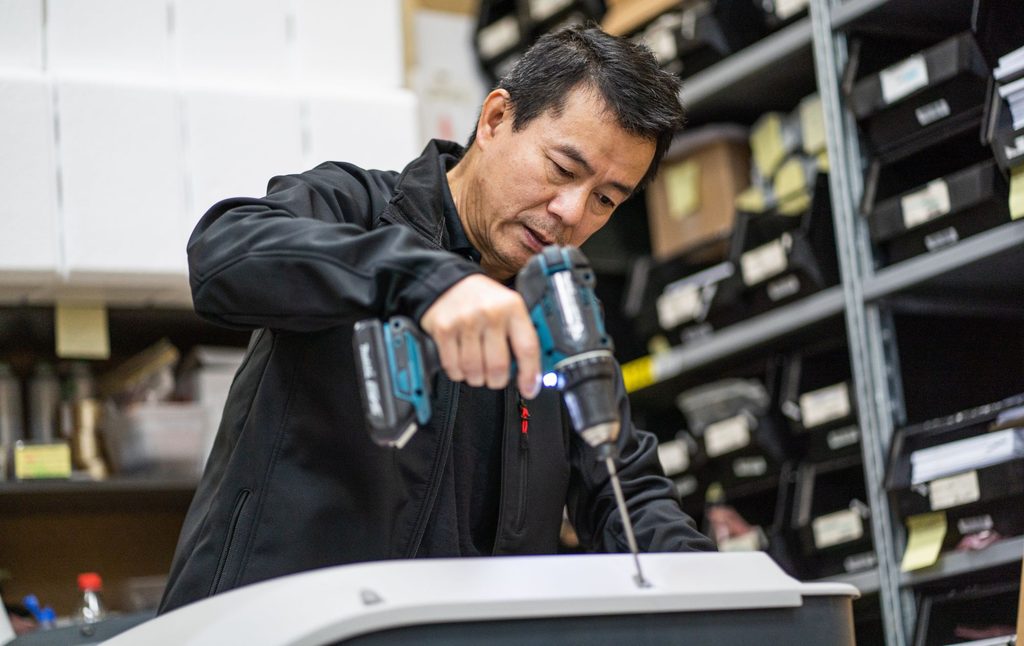
However, a long service life is not only about warranty coverage. What truly matters is having local expertise, technical support, and repair capabilities available when they are needed. That’s why Fronius operates a dedicated repair centre in Melbourne, providing Australian customers with local service and support throughout the life of their system.
Unlike products that are simply replaced when a fault occurs, Fronius has a long-standing commitment to repairability. Our Melbourne repair centre enables many products and components to be assessed and repaired locally, helping customers get their systems back online faster while reducing unnecessary electronic waste. This approach not only supports system longevity but also aligns with our commitment to sustainability and responsible resource use.
Combined with monitoring through Fronius Solar.web, access to local technical support, and a strong network of trained installation partners, Fronius customers benefit from a complete support ecosystem designed to help maximise system performance over many years.
While no manufacturer can guarantee a specific product lifespan, our focus on quality engineering, local service infrastructure, repairability, and long-term support is designed to help customers get the most value from their solar investment for years to come.
What should you ask before buying an inverter?
Ask:
- What written warranty applies to the exact model?
- Is registration required, and by when?
- What does the warranty cover: parts, labour or service, transport, or another combination?
- Who is the first support contact if something goes wrong?
- Is monitoring included and what information will you be able to see?
- Is qualified service available in your area?
- Are parts or replacement pathways documented?
- How could a future battery, backup requirement or system expansion affect compatibility?
- What happens if the original installer stops trading?
For the broader relationship between installer quality, manufacturer continuity and after-sales support, see solar partners and long-term support.
Frequently asked questions
How long do solar inverters last?
Australian Government guidance gives average planning ranges of 10 – 15 years for string inverters. These are not guaranteed failure dates.
Is solar inverter life expectancy the same as the warranty?
No. A warranty is contractual protection under stated terms. It is not a prediction of when the inverter will fail or proof of how long it will remain operational.
Does heat shorten inverter life?
Heat and thermal conditions are relevant to power-electronic reliability, but there is no universal homeowner formula that converts temperature into years of life. Australian Government guidance advises keeping string inverters out of direct sunlight, and actual siting requirements should follow the product documentation.
Should I replace an inverter as soon as it reaches 10 years?
Not simply because of age. Condition, diagnosis, fault history, warranty, parts and service availability, compatibility and future system plans all matter.
Can monitoring extend an inverter’s lifespan?
Monitoring can help you notice alerts or changes and provide useful service records. It does not guarantee longer physical life or prevent every failure. Fronius Solar.web, for example, provides system monitoring for compatible installations.
Plan for service life, not a guaranteed expiry date
The most useful answer to how long do solar inverters last is a planning range combined with evidence about the individual system.
Australian Government guidance gives a useful starting point, independent field research shows that first faults are spread across many years, and manufacturer warranties explain contractual coverage. None of those sources can predict the exact failure date of one inverter.
For owners, the practical approach is to monitor, maintain the system according to its documentation, act on warning signs and seek professional diagnosis before deciding to repair or replace. For buyers, look at serviceability, warranty terms, support access and future system compatibility as well as the initial purchase price.