A home energy management system (HEMS) is an energy management system (EMS) designed specifically for private households. It automatically controls electrical appliances, battery storage systems, heat pumps, and electric cars to maximize self-consumption and reduce energy costs. This can only be achieved with the help of PV monitoring. We’ll show you how to get the most out of modern tools.
Today’s PV systems can do more than just generate electricity. With the right tools and strategies, you can use the energy you generate more efficiently than ever before and unlock the full potential of your solar power. Thanks to PV monitoring and HEMS. Although the two terms are inextricably linked, they refer to different processes.
Solar monitoring: what an energy monitoring system shows you
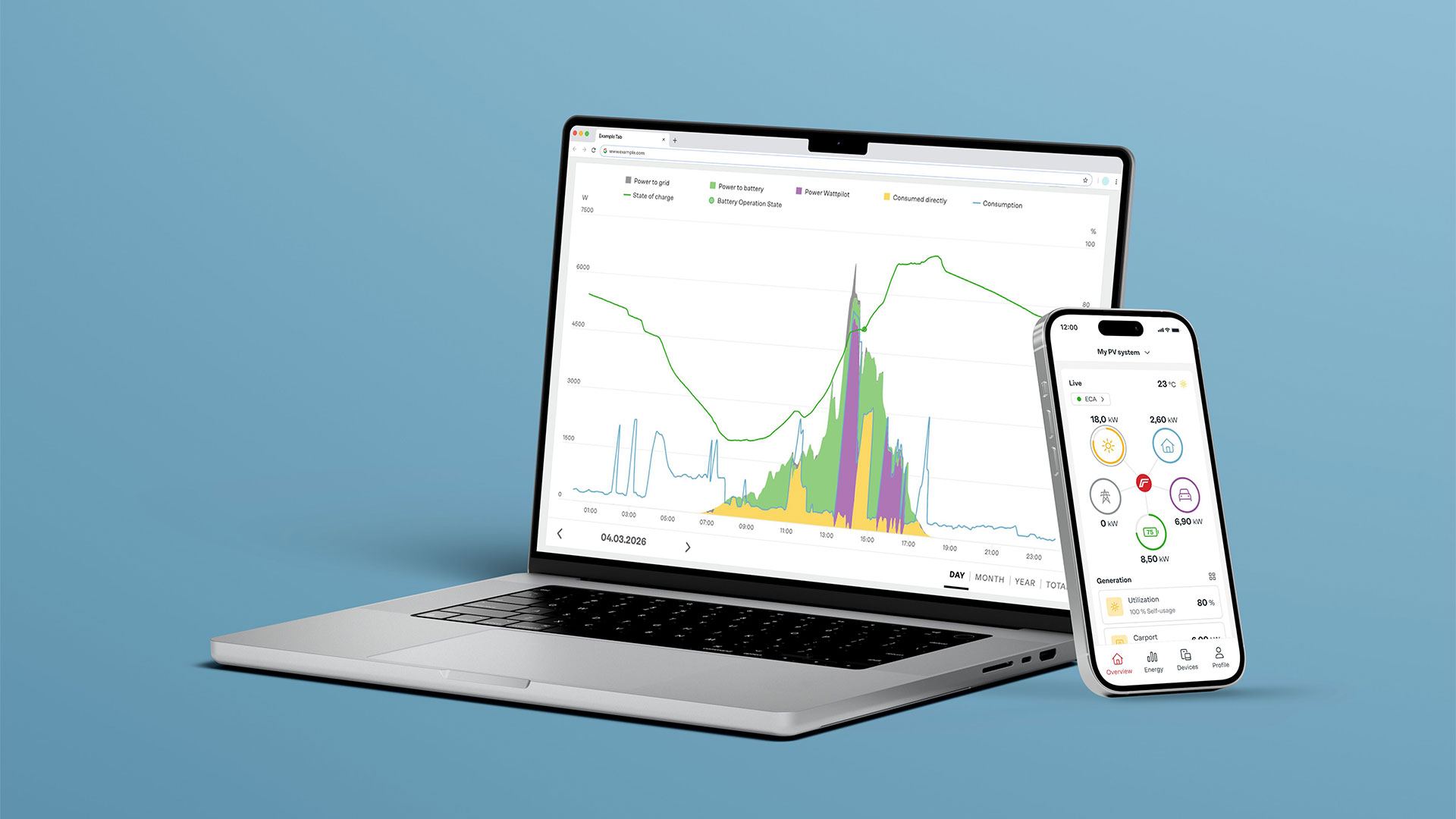
Tools for energy monitoring collect essential data from a PV system and display these clearly on digital platforms. The required data comes from smart meters, the inverter, or the charging station itself. Monitoring platforms vary depending on the manufacturer. Our solution, Fronius Solar.web, displays the following data, for example:
- Current PV generation
- Daily, monthly and annual yields
- Household electricity consumption
- Grid consumption and grid feed-in
- Battery storage state of charge
- State of charge of the electric vehicle
- Maintenance instructions
Kilian Schachtner, a solar expert at Fronius International GmbH, understands the connection between monitoring and energy management: “The monitoring data allows you to see how efficiently you’re using the electricity generated by your own roof. Energy monitoring thus allows for a transparent representation of energy flows. This, in turn, forms the basis for effective energy management.”
What is a home energy management system (HEMS)?
A HEMS consists of a software solution—often AI-based—and physical measurement and control units. It’s hard to imagine modern households without them. While an energy management system (EMS) controls the energy needs of rooms, plants, warehouses, and entire building complexes, a HEMS is specifically designed to optimize electricity flows within a household. Simply put, every HEMS is an EMS, but not every EMS is a HEMS.
Owners of PV systems benefit the most, because the goals of PV energy management are:
- Increasing self-consumption
- Reducing grid consumption
- Maximizing PV yield and reducing costs
If you already own a PV system, you may be wondering: “Isn’t my monitoring tool enough for that? Is a HEMS even worth it?”
The solar expert provides a clear answer: “Yes! After all, the goal of an energy management system is to minimize energy costs. To do this, it analyzes the data provided by the monitoring system and, based on that data, automatically makes decisions. The benefits are obvious: greater cost savings without having to worry about energy management. The system handles everything on its own and adapts to your electricity usage behavior.”
The interplay between energy management and PV monitoring
When PV monitoring provides the EMS with real-time data, it opens up a wide range of possibilities. While a typical residential PV system without battery storage usually allows for the self-consumption of only 20 to 35% of the PV electricity, this percentage increases with a storage solution to approximately 50 to 70%.
An energy management system can typically increase the self-consumption rate by 10 to 20% compared to an uncontrolled PV system. When combined with battery storage, a heat pump, and an electric car, self-consumption rates of 60 to 80% are achievable. In addition, a modern software solution helps preserve the battery storage system and avoid feed-in limits.

This table illustrates the additional features that a modern home energy management system offers compared to PV monitoring alone:
| Function | PV monitoring | HEMS |
|---|---|---|
| Capture data | Yes | Yes |
| Visualize energy flows | Yes | Yes |
| Charge and discharge battery storage systems intelligently | No | Yes |
| Regulate charging for electric cars | No | Yes |
| Automatic heating and cooling using surplus PV energy | No | Yes |
| Prioritize individual loads | No | Yes |
| Take variable electricity rates into account | No | Yes |
| Prepare and incorporate weather and yield forecasts | No | Yes |
We’ll explain which energy management system is right for your PV system below. First let’s take a look at the basic features.
What are the key features of a home energy management system?
1. Using more of your own solar power
If a surplus of PV energy is generated on sunny days or while the residents are away, an energy management system makes the best possible use of the available electricity within the household rather than feeding it into the public grid. The latter has become less lucrative in recent years. In many regions, utility companies even prohibit feeding electricity into the grid to prevent overloading the public grid.
2. Managing battery storage intelligently
As mentioned earlier, battery storage systems such as the Fronius Reserva and the Fronius Reserva Pro play a key role in increasing self-consumption. HEMS maximize the benefits of home energy storage systems. For variable electricity tariffs, they take into account the current price on the electricity exchange and the weather forecast for the coming days. Based on the data, the software independently decides when the battery storage system charges and discharges.
Incidentally, you can learn how to retrofit a battery storage system into an existing PV system and how much storage capacity is worthwhile for your household in this blog post.
3. Optimizing heat production using solar energy
Heat can be easily stored, for example as hot water in a boiler or as residual heat in a building. An efficient energy management system takes advantage of this: Heat pumps or secondary regulators such as the Fronius Ohmpilot ensure that heat is generated specifically when a lot of solar power is available or when the price of electricity is low. The stored heat covers demand for several hours, even if no solar power is being generated in the meantime and no cheaper electricity is available.

Did you know? Air conditioning systems can also be integrated into the system, so that solar energy is used not only for heating but also for cooling.
4. Charging an electric car smartly
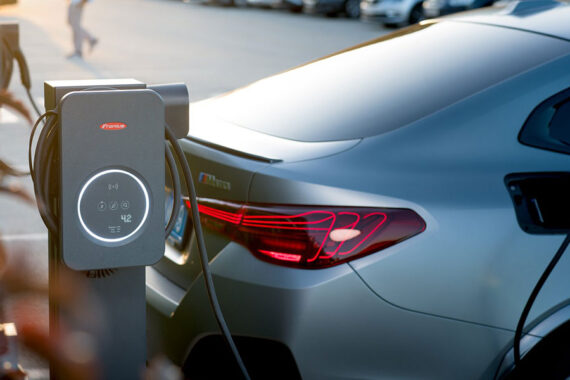
Depending on the type of charging station you have, you can charge your electric vehicle according to your needs. To determine the optimal charging strategy, your energy manager takes into account factors such as your desired departure time, distance, and charging priorities when charging multiple vehicles simultaneously, and ensures that the battery is sufficiently charged by the selected time.
More about e-mobility
You can find tips for extending your range and battery life here. Do you drive a company electric car and sometimes charge it at home? In this interview, our e-mobility expert explains how you can conveniently bill your employer for charging costs using select charging stations, such as our Fronius Wattpilot Flex.
5. Prioritizing household energy loads
Some energy management systems can prioritize loads. This means you can decide whether surplus PV energy should go toward charging the battery storage system or the electric car.
Here’s what the prioritization list might look like:
- Battery storage
- Water heating (for example, using the Fronius Ohmpilot)
- Heat pump
- Individual loads (e.g., pool pump, air conditioner)
- …
In this case, the electric car would be charged with PV electricity only if the battery storage system is already fully charged and the heat supply is secured.

6. Learning and analyzing your energy use with AI
Modern energy managers are AI-powered. This means that they can identify patterns in the household’s electricity usage behavior. Together with the weather forecast and the current electricity price, they can use what they have learned as the basis for their calculations.
Let’s look at this using a real-world example:
An electric car owner comes home one summer evening. He plugs the car into the charging station. He spends his evening cooking and eating with his family, followed by a shower and watching TV. He goes to bed around midnight. Since electricity consumption was low during the day, his PV system was able to fully charge the battery storage system, so that it is still about 60% full even at night. HEMS also picks up on this; it incorporates weather data into its energy generation and consumption forecasts and “knows” that the electric car leaves the property between 7 and 8 am on most days. Since another sunny day is on the horizon, the PV energy management system decides to charge the electric car overnight using electricity from the battery storage system. The energy drawn for the car makes room for the expected surplus PV energy the following day.
However, it is important to note that it’s not just the weather forecast and the expected surplus PV energy for the following day that play a role in the decision to charge the car using electricity from the battery storage system. An efficient HEMS must also take into account the feed-in tariff, the price of electricity, and the wear and tear on the storage system caused by additional battery cycles. Especially with variable electricity tariffs that offer particularly attractive prices at night, discharging the battery storage system to charge an electric car is not always the most economical option.

Good to know: In Fronius Solar.web Premium, the Fronius Energy Cost Assistant (ECA) is responsible for taking weather data and current electricity prices into account. You can turn this feature on and off in the app as you like.
Which EMS is right for you?
Not every EMS performs equally well in every PV system. Depending on the existing or planned future PV components, various software solutions are available.
In addition to manufacturer-specific systems, called proprietary systems, there are manufacturer-independent providers. Proprietary systems are optimally designed to work with devices from the same manufacturer. This leads to greater efficiency. On the other hand, third-party components are often difficult, if not impossible, to integrate into the system.
Manufacturer-independent EMS systems circumvent this problem through open interfaces and a high degree of compatibility with as many different product providers as possible. This allows for maximum flexibility in equipment selection and in the retrospective integration of an EMS into an existing PV system, but results in greater installation work.
Fronius Enia: smart energy management for homes and businesses
“Our energy management solution Fronius Enia combines the best of both worlds. It is perfectly integrated with Fronius products, but its open interfaces also allow for the connection of ‘third-party’ components,” says Kilian Schachtner. “Enia offers another advantage: As a full-fledged energy management system—EMS for short—it evolves to meet changing needs and goes beyond the traditional single-family home. It is also suitable for companies.”
How to use variable electricity tariffs
To wrap up, let’s take a look at the variable electricity we mentioned earlier. When combined with smart energy management, they open up new opportunities for significant cost reductions. That’s because electricity is cheapest at midday and at night, precisely when demand is at its lowest. Intelligent software, such as the Fronius Energy Cost Assistant, can incorporate daily updated prices from the electricity exchange into its calculations and power energy-intensive loads, such as heat pumps, using low-cost electricity during midday and nighttime hours. It can also charge electric cars and battery storage systems with low-cost electricity. This strategy minimizes costly grid consumption.
Variable electricity tariffs are particularly popular in Scandinavia. In Norway, for example, more than 90% of all households purchase their electricity under dynamic tariffs; fixed-rate plans are the exception. In Sweden, too, variable tariffs account for more than half of all tariffs. In countries like Austria, the situation is the opposite. Fixed-rate plans are the rule, not the exception. But that could change: Starting in 2025, every Austrian electricity provider must offer at least one variable tariff.
Conclusion: why solar monitoring and a HEMS pay off
Can an energy management system lower my energy costs and improve the cost-effectiveness of my PV system? To sum up, Yes! But only with the right tools, which allow you to analyze PV system data.
After all, solar monitoring and energy management go hand in hand. Only when accurate system data is available in real time can a specialized home energy management system for your home optimize energy flows and thereby increase self-consumption and reduce energy costs.
When choosing an energy management system, make sure it is compatible with all of your devices. Open interfaces are essential if you have components from different manufacturers.
For systems that consist, at least in part, of Fronius devices, Fronius Enia is a good choice. Our energy management system combines perfect integration with Fronius components with compatibility with third-party components. It is equally suitable for homes and businesses.
FAQ
What is a HEMS?
A Home Energy Management System (HEMS) is a smart software solution for controlling energy flows in the home. The system analyzes data from the PV system, storage unit, heat pump, and charging station, and automatically optimizes the use of solar power for self-consumption.
What is an EMS, and how does it differ from a HEMS?
EMS stands for Energy Management System and is the generic term for systems used to monitor and control energy flows. They are used in private homes, commercial buildings, and industrial facilities.
In short, every HEMS is an EMS, but not every EMS is a HEMS.
What’s the difference between PV monitoring and HEMS?
PV monitoring visualizes energy flows and system data. A HEMS goes one step further and automatically controls loads such as battery storage systems, heat pumps, and charging stations. Monitoring provides the data, and HEMS makes decisions based on it.
Do you need a Smart Meter for PV monitoring?
Yes, a Smart Meter is required for reliable and comprehensive system monitoring. It provides specific figures on household electricity generation and consumption.
Can PV monitoring increase my self-consumption?
PV monitoring alone does not directly increase self-consumption. However, it shows when electricity is generated and consumed. This enables loads to be used specifically during periods of high solar power generation. When used in conjunction with a HEMS, this optimization occurs automatically.
Which HEMS is the right one?
The choice depends on the components you already have. Compatibility with PV systems, storage units, heat pumps, and charging stations is important, as are open interfaces for future expansions.
What is Fronius Enia?
Fronius Enia is our energy management solution. Not only is it perfectly tailored to all Fronius devices, but thanks to open interfaces, it also allows for the integration of many third-party components.
Enia is a fully-fledged EMS. Businesses also benefit from the smart energy manager.
Can an EMS control multiple charging stations?
Yes, an energy management system can charge multiple electric vehicles simultaneously in a smart and cost-effective way.
To what extent can a HEMS increase self-consumption?
That depends heavily on the system configuration. How large is the system, how much electricity does it consume, in which direction are the panels oriented, and how large is the battery storage system, if there is one?
Roughly speaking, HEMS increase self-consumption in systems without battery storage to 40 to 50%, provided that household appliances and any heat pumps can be operated when the sun is shining.
With a storage system, a HEMS can even achieve an self-consumption rate of up to 80%. The integration of large loads such as heat pumps and charging stations significantly increases the potential for self-consumption.
Is a HEMS worth it without battery storage?
Generally speaking, yes (see Question 8). The greatest cost savings can be achieved through the integration of a HEMS when controllable large loads, such as heat pumps and charging stations, are present in the household. Variable electricity tariffs can further reduce energy costs.
Does a HEMS work with variable electricity tariffs?
Yes, it does. A HEMS retrieves the current price data from the electricity exchange at regular intervals and uses this information to determine when heat pumps and charging stations can be operated most efficiently and when electric vehicles and home storage systems can be charged as cost-effectively as possible.