Summer and sun go hand in hand with solar power, but what happens in winter? PV systems are also reliable electricity generators in the winter months, albeit with lower yields because the sun is lower and the days are shorter. However, contrary to popular belief, cold and snow can actually have a positive effect on performance. Read on to find out why this is the case, how do photovoltaics work in winter, how to make your PV system fit for winter, and how to make optimum use of your own solar energy in winter—either for heating or in combination with a battery.
Why photovoltaics also works in winter
It is easy to explain why a photovoltaic system produces less electricity in the winter months: fewer hours of sunshine mean lower energy output.
Part of the reason is due to lower solar radiation (global radiation)
The tilt of the Earth’s axis means that the sun sits lower in the sky in the northern hemisphere during winter. The position of the sun is flatter and the sun’s rays are not perpendicular to the modules but instead are at an acute angle. Less direct radiation means less energy production per square meter overall. In addition, the intensity of the radiation decreases in winter because the light also travels a longer distance through the Earth’s atmosphere when the sun is low—meaning part of the radiation is absorbed by clouds, dust, water vapor, and other particles on the way.
Shorter days and more difficult weather conditions add to the problem
In winter, the days are significantly shorter, which greatly reduces the number of hours with direct sunlight even in clear conditions. Typical wintry weather (more cloud cover, fog, and snow) also contributes to weaker solar radiation.
However, PV systems also use diffuse radiation. Diffuse radiation does not come directly from the sun but is instead scattered by air molecules or water particles in the atmosphere. It is thanks to this scattered radiation that the electricity production of a PV system remains stable on cloudy, overcast winter days, albeit at a lower yield.

What effects does the low position of the sun in winter have on the design of PV systems?
Consequently, the modules should be installed at a steeper angle due to the flatter angle of incidence. While rooftop systems with module inclinations of between 10 and 30 degrees are ideal in summer, roof stands with steep mounting angles or façade systems with modules mounted high on the building offer significant advantages in winter. The latter are also less susceptible to prolonged periods of shade or partial shade in winter.
Additional potential mounting areas such as fences or garden walls can also be optimally utilized with vertically mounted modules. Another advantage is that snow barely sticks to modules in façade systems and frost thaws more quickly—a practical solution in particularly snow-prone regions.
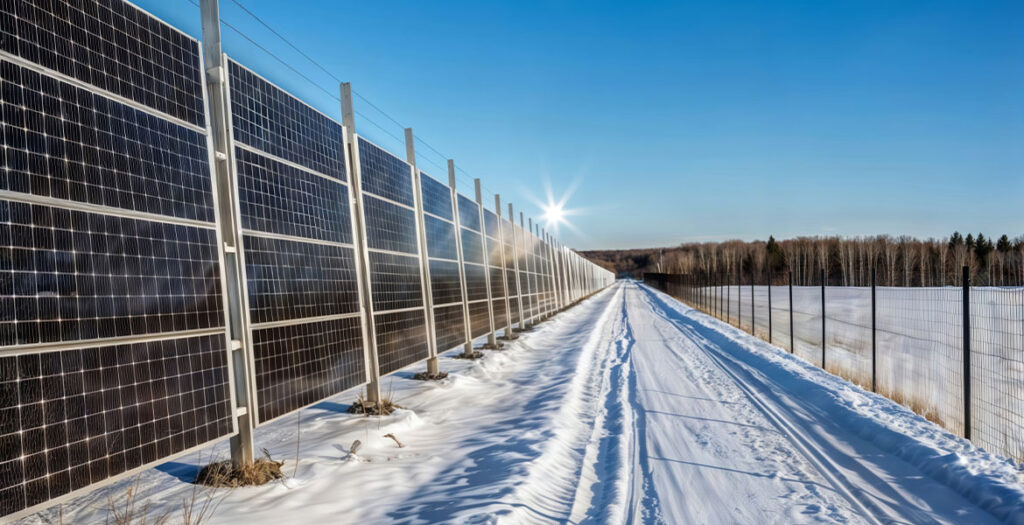
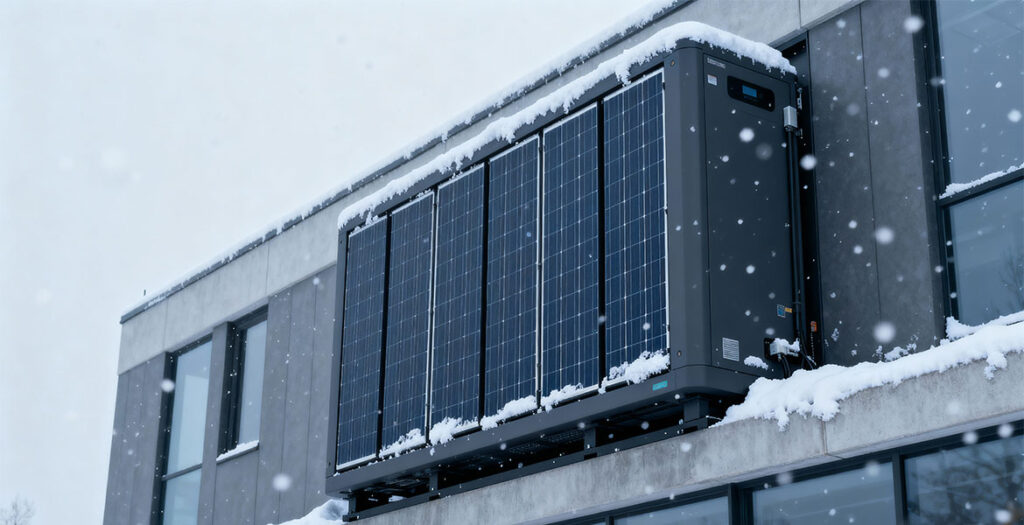
Efficient even in winter: vertical PV systems make optimum use of the low angle of the sun.
How much electricity can be produced with PV in winter?
From around March to October in our latitudes, an efficient PV system can achieve a high level of self-sufficiency in your own energy supply, especially in summer when a lot of surplus energy can be expected. A south-facing PV system achieves daily yields in summer that are five to six times higher than the dimensioning. For a 10 kWp system, this means around 50 to 60 kWh per day.
In winter, on the other hand, the yield is much lower for the reasons mentioned— a rooftop system only generates around 10% at this time of year. With a 10 kWp system, this is around one kilowatt hour per day, while a south-facing façade system of the same size can produce roughly 10 kWh per day. These yields primarily apply to the three months of November, December, and January. The monthly yields from April to September are usually very high, which is why the average annual yield of a PV system is still excellent.
| 8 kWp | Orientation | East-West 30° | South 30° | South façade 90° (2023) |
|---|---|---|---|---|
| January | PV yield | 210 kWh (with snow < 100 kWh) | 380 kWh | 450 kWh |
| February | PV yield | 370 kWh (with snow < 200 kWh) | 580 kWh | 600 kWh |
| March | PV yield | 680 kWh (with snow < 420 kWh) | 920 kWh | 790 kWh |
So is energy self-sufficiency actually possible in winter? It all comes down to consumption.
Covering the entire energy demand in the cold season with photovoltaics alone appears unrealistic, but oversizing your PV system over the whole year is likely to be highly worthwhile. It’s essential to take a range of factors—such as the heating system—into account here. For example, a single-family home with a pellet heating system and consumption of around 8 kWh per day can achieve a high degree of self-sufficiency (up to 90%) in winter, if the PV system is well located and oriented. Conversely, even a low-energy house with a 10 kWp PV system including a heat pump can be expected to achieve a maximum 20% self-sufficiency in winter because the daily electricity demand for the heat pump alone is 10 to 40 kWh.
Planning tips for achieving maximum efficiency with your PV system in winter:
- Select the ideal combination of south and east-west orientation with three strings.
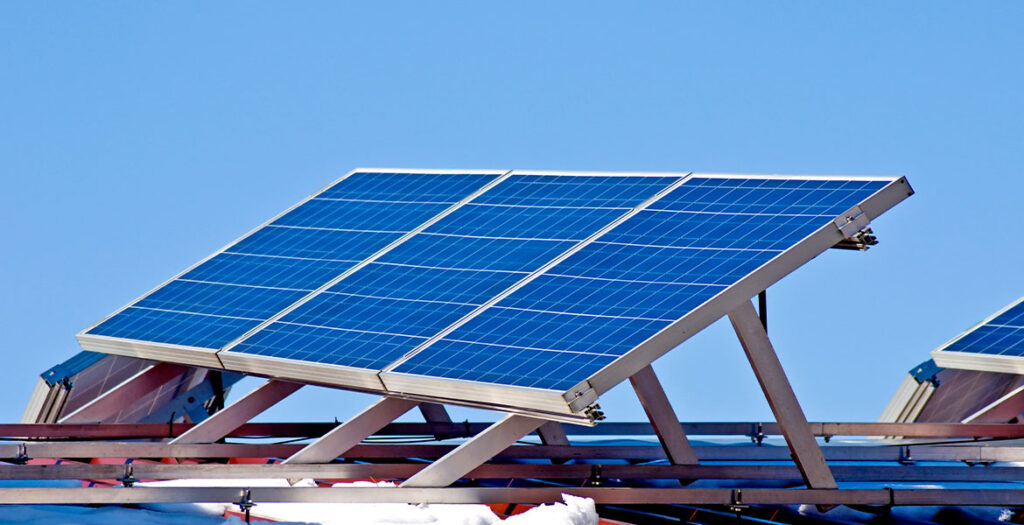
- Optimize the module inclination angle for a low sun position—the ideal inclination on the roof for maximum winter yields is 20 to 50°. Seasonal adjustment is an option thanks to adjustable mounting systems.
- Consider a south-facing vertical PV system/façade system, especially in snowy areas.
- Install bifacial solar modules, which can utilize light on both sides. These modules make particularly effective use of the so-called albedo effect—the reflection of bright surfaces such as snow.
- If necessary, dimension the photovoltaic system slightly larger (depending on heat pump consumption + 3-5 kWp)—consider the annual balance!
Did you know?
Is it true that photovoltaic systems are more efficient in cold weather?
Yes, tend to work better at colder temperatures because the ambient temperature has a direct effect on the efficiency of the solar cells.
The so-called temperature coefficient is a key performance indicator for solar modules, giving the percentage by which the module’s output increases or decreases per degree Celsius change in temperature compared to the standard test condition (= 25 °C). Solar modules largely consist of crystalline silicon and have a negative temperature coefficient of approx. -0.3 to -0.5% per degree Celsius. The module output drops by precisely this percentage for every degree Celsius above the test temperature of 25 °C.
Why is that? As temperatures rise, the voltage decreases while the current increases only slightly, resulting in the overall electrical power decreasing because it is the product of voltage and current. Conversely, this means that performance increases as soon as temperatures fall. At low temperatures, the voltage of the modules remains higher and the overall output increases. Chilly sunny days can therefore be more productive than hot summer days.
Winterizing your PV system
First things first, regular maintenance and careful monitoring of the photovoltaic system are fundamental to enjoying optimal energy output and longevity. So if you always keep a close eye on your PV system—both online in the monitoring app and directly on the roof—you can respond quickly to irregularities and largely avoid surprises caused by technical problems, even in winter. Tip: carrying out a quick professional check in late fall pays off, ensuring that the system starts the winter season with clean surfaces and full performance.
Photovoltaic System and snow
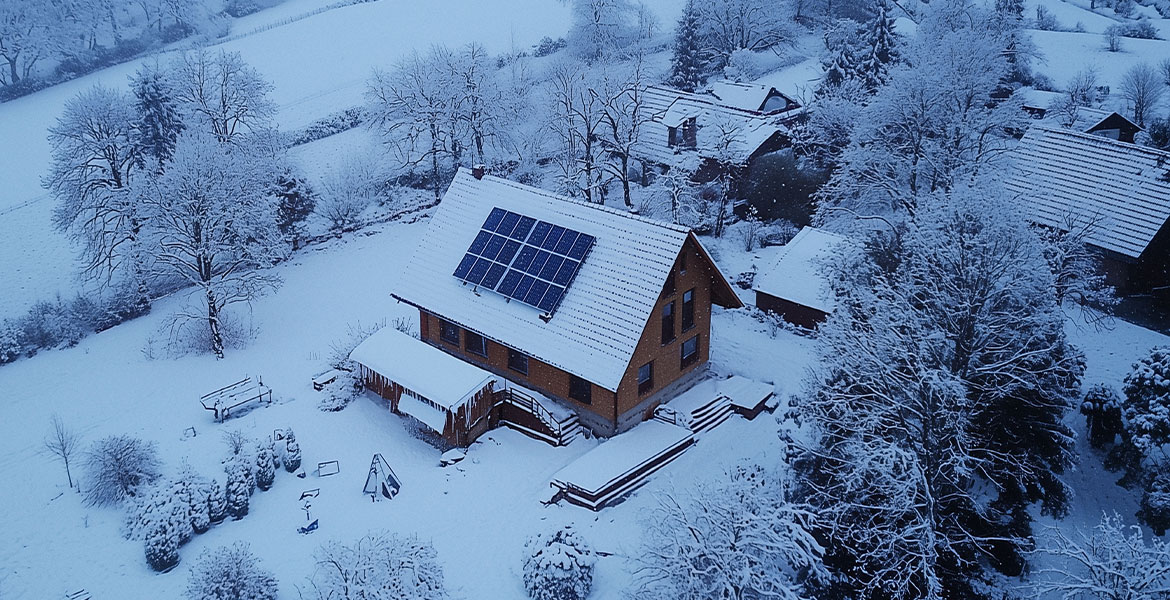
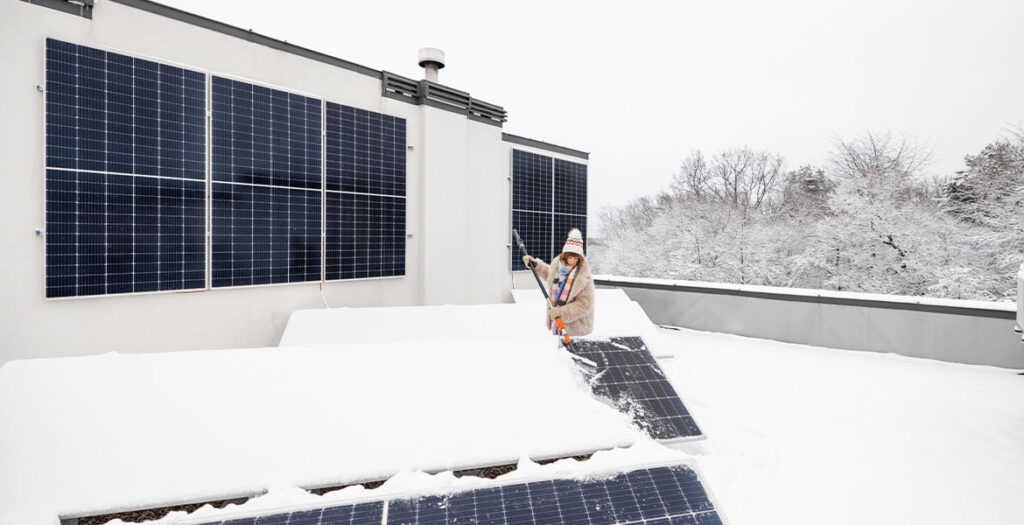
Does snow on the modules mean no solar power? Yes and no. Modules can generate electricity with diffuse light, even when covered with a loose layer of snow a few centimeters deep. The heat from the modules together with a greater tilt angle causes snow and ice to melt and slide off unassisted. So the modules usually clean themselves.
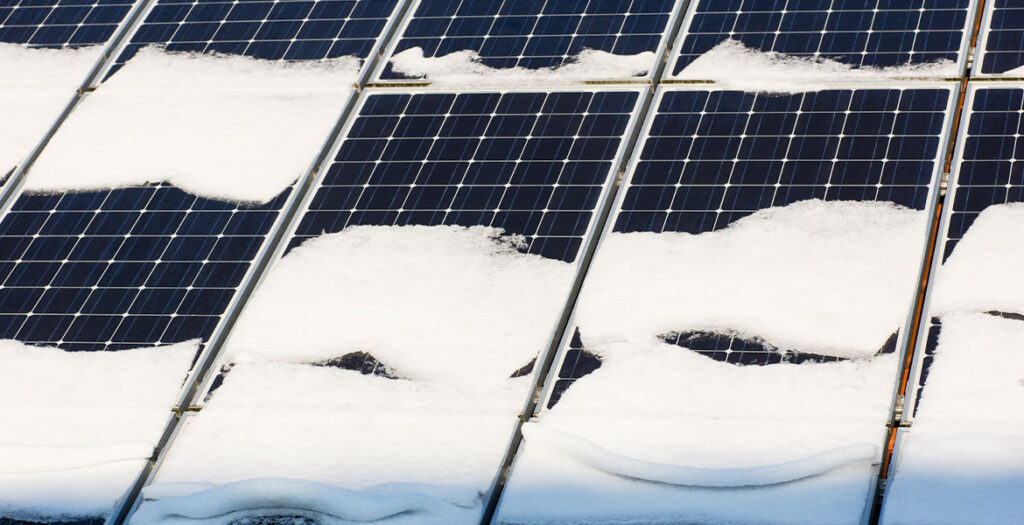
But if there is a thick layer of snow deeper than 15 centimeters on the roof, sunlight can no longer penetrate to the photovoltaic modules. In this case, it’s necessary to carefully weigh up the advantages and disadvantages of snow clearance. How high are the actual energy losses and the associated electricity costs?
If it is a matter of higher costs for a short period of time, it may be best to accept this loss rather than hiring a professional snow clearing company. In locations at higher altitudes with consistently high snow loads or where there is a risk due to extremely wet, heavy snow, it’s advisable to remove the snow and relieve the load. Once again, please make sure you only allow professionals with special equipment up on the roof—the risk of accidents is far too great for amateurs. If necessary, clear accessible areas of the system from the ground using soft tools such as snow brushes with soft bristles or telescopic pushers. Never use road salt—the salt particles damage the modules and lead to a loss of performance.
Checklist for optimizing self-consumption in winter:
1. Use battery storage:
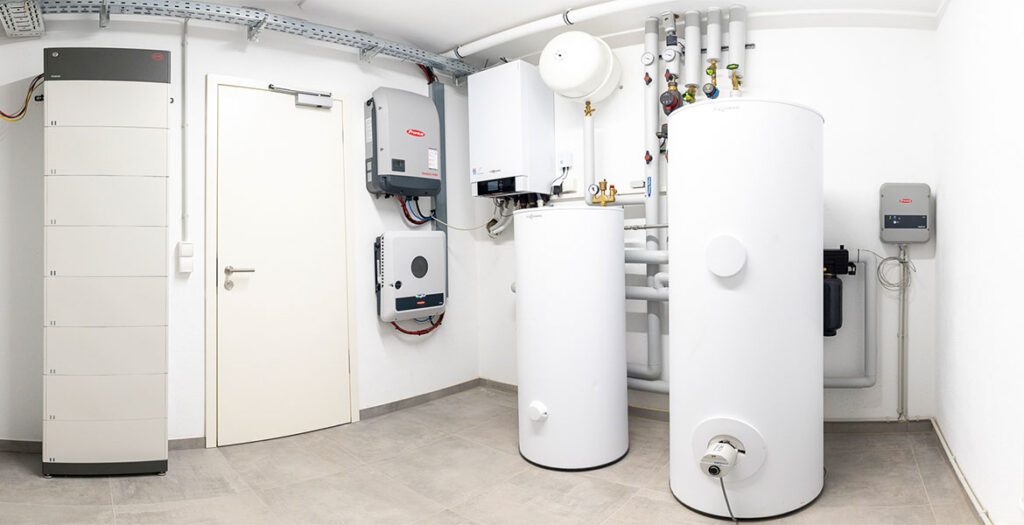
Surplus PV electricity is stored in the battery during the day and made available later on; in the winter months where there’s little to no PV surplus and with variable tariffs, it makes sense to charge the battery with cheap grid current and then fall back on it when grid current becomes pricier again.
2. Heating and hot water with PV:
Your own solar power can also be used for heating and generating hot water in winter. Load regulators like the Fronius Ohmpilot use even the smallest amounts of PV surplus to control the heating element in the boiler or buffer tank and keep the water temperature in it constantly high. Coupled with photovoltaics, heat pump operation is also more efficient: The heat pump does not have to switch itself on and off as often, which reduces the load on the entire household heating system and makes it last longer.

3. Intelligent energy management
With a monitoring tool such as Fronius Solar.web, you always have an overview of yield and loads, and even hidden power guzzlers in the household, and you can make specific settings to ensure your PV system works even more efficiently.
Intelligent AI-based energy management tools such as the Fronius Energy Cost Assistant continuously analyze the expected electricity production, consumption, and current electricity prices, and optimally adapt the battery’s storage strategy accordingly. This makes efficient use of energy resources and effectively saves electricity costs.

4. Adjusting the timing of consumption
If energy-intensive appliances such as washing machines, dishwashers, etc. run when the PV system is producing a lot of solar power—i.e. primarily around midday in the winter—this has a positive effect on self-consumption. In addition, load shifting and changes in your own energy consumption behavior also have an impact on your wallet.
5. Charging an electric car
Even if the photovoltaic system energy output and surplus are lower in winter than in summer, it makes sense to charge your electric car using your own solar power: once again, it’s important to adjust the daytime charging times to the sunniest hours around midday. Smart charging boxes allow dynamic PV surplus charging and can also automatically use variable electricity tariffs at low tariff times overnight.
Tip: the PV-optimized Fronius Wattpilot Flex charging solution can automatically switch between 1-phase and 3-phase charging and thereby utilize even the smallest PV surplus of 1.38 to 22 kW—ensuring that no ray of sunshine goes unused, even in winter.
Conclusion: Is photovoltaics worth it in winter?
On the shorter winter days, photovoltaic systems in our latitudes produce significantly less electricity than in summer. However, with appropriate system planning—e.g., with a south-facing façade system or modules set at higher inclination angles—it’s possible to make the best possible use of the sun even in winter. Smart energy management tools help to efficiently integrate the battery storage system, charging station, and load regulator into the overall energy system and increase self-consumption at the same time. Meaning that a certain degree of self-sufficiency is possible even during the chilly winter months.