You can already use the PV electricity you generate during the day, but what about at night or during power outages? There are several aspects you need to consider for round-the-clock availability: not only the number of PV modules and type of inverter, but also what battery capacity would be the most economically sensible. The choice of energy storage device to install also depends on whether you are purchasing a new photovoltaic system complete with battery as a single package or retrofitting a storage solution to an existing setup. In the following blog post, we explain how the right PV storage device can complete your system.
Table of content
Photovoltaics with battery storage is fully on trend. And no wonder—after all, energy storage devices increase the self-consumption rate of self-generated solar power by making the energy from your own roof available when the sun isn’t shining. In other words, you can use the electricity you’ve generated in the day during the evening and at night—which is exactly when energy demand peaks in many households.

Energy storage solutions are also an important security guarantee in the event of a blackout, which can also occur in Europe. With many homeowners looking to boost their resilience against such risks, Full Backup (the most comprehensive emergency power function of a PV system) is more in demand than ever.
How much storage capacity makes sense?
Are you also thinking about retrofitting an energy storage device to your existing PV system and taking your energy supply to the next level? Or are you planning to install a completely new PV system including battery storage?
In both cases, you’re probably wondering whether this investment makes financial sense for your household and how much storage capacity you actually need.
To find the answer, you first need to ask yourself three questions:
- How many kWh does your household consume per year?
- How much of you household’s energy demand occurs in the evening (after sunset) and at night?
- How large is your existing or planned PV system?
“It stands to reason that the more electricity generated on your own roof and the more of it that is needed in the evening and at night, the larger the energy storage device should be,” explains Maximilian Schett, solar expert at Fronius International. However, while more storage capacity goes hand in hand with more independence and self-consumption, the initial investment for a storage solution should not be underestimated. After all, every kWh of storage capacity comes at an average cost of 1,000 euros and the time needed until a PV system with an oversized battery delivers a return on investment is much longer. For this reason, it is generally accepted that a self-consumption rate of at least 60% is necessary for a setup to be economically viable.
“If a household consists exclusively of working people who are out during the day and only come home in the evening, more storage capacity is certainly useful. In this scenario there is nobody at home to consume the electricity while it is being generated. Instead there are power peaks in the evening and morning, such as when cooking dinner or charging an electric car,” adds Schett.
The following rules of thumb* will help you to estimate how much storage capacity you need based on your daily energy consumption:
| Average electricity consumption during the day | Low electricity consumption during the day |
| Annual electricity consumption in kWh / 1000 × 1.2 = storage capacity in kWh | Annual electricity consumption in kWh / 1000 × 1.5 = storage capacity in kWh |
*Please note: This information is intended as an approximate guide for the required storage capacity. Your installer will take your individual energy requirements into account in their quotation.
If the PV system generates surplus energy during the day and a lot of electricity is consumed in the evening, investing in a larger PV storage system can be worthwhile, according to the solar expert.
However, it is not automatically the case that the larger the storage capacity, the greater the degree of independence. The graph below illustrates this using the example of a household with a 10 kWp PV system, a heat pump, and an annual electricity consumption of 7,500 kWh. Without a storage solution, the example household can only cover 43% of its annual electricity needs with solar energy.
If the household invests in a smaller energy storage device with a capacity of 6.3 kWh, the self-sufficiency rate increases to more than two thirds. A higher charging capacity of 9.5 kWh moderately increases the degree of self-sufficiency even further: more than three quarters of the electricity demand can be covered by self-generated solar energy. An even larger energy storage device with a storage capacity of 12.6 kWh, on the other hand, only marginally increases the degree of independence.
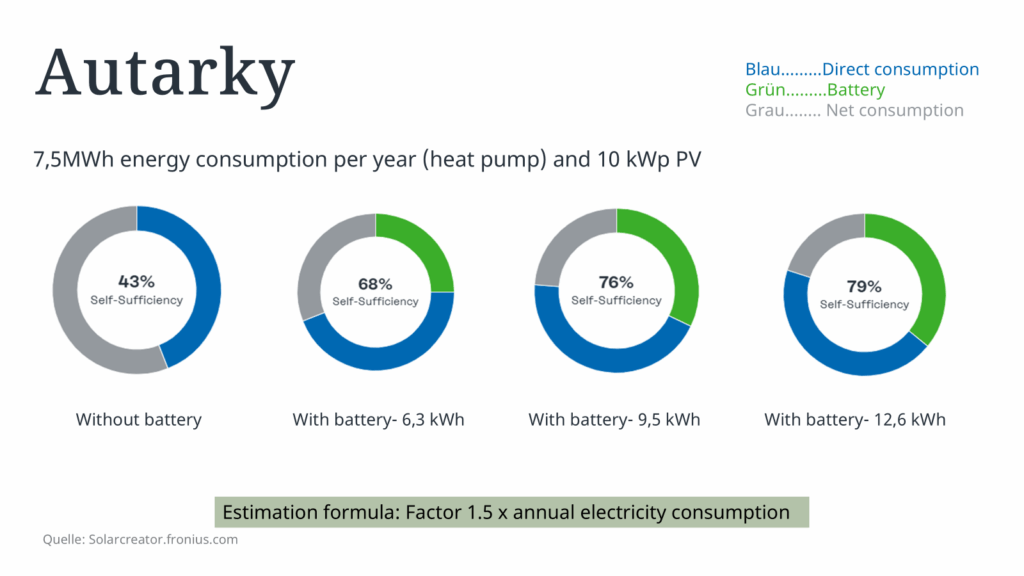
So as you can see, while a small and, strictly speaking, undersized solar battery can significantly increase the level of self-consumption on its own, the degree of independence increases only slightly with an adequately or oversized storage solution—and ultimately, from a certain number of kWh, there is no further improvement at all.
Retrofitting a battery
If your PV system is already generating a surplus of solar power but you’ve got no way of storing it, there is no need to despair: storage solutions can be retrofitted in many cases with the latest solar technology. Usually there are two main options here:
DC high-voltage batteries
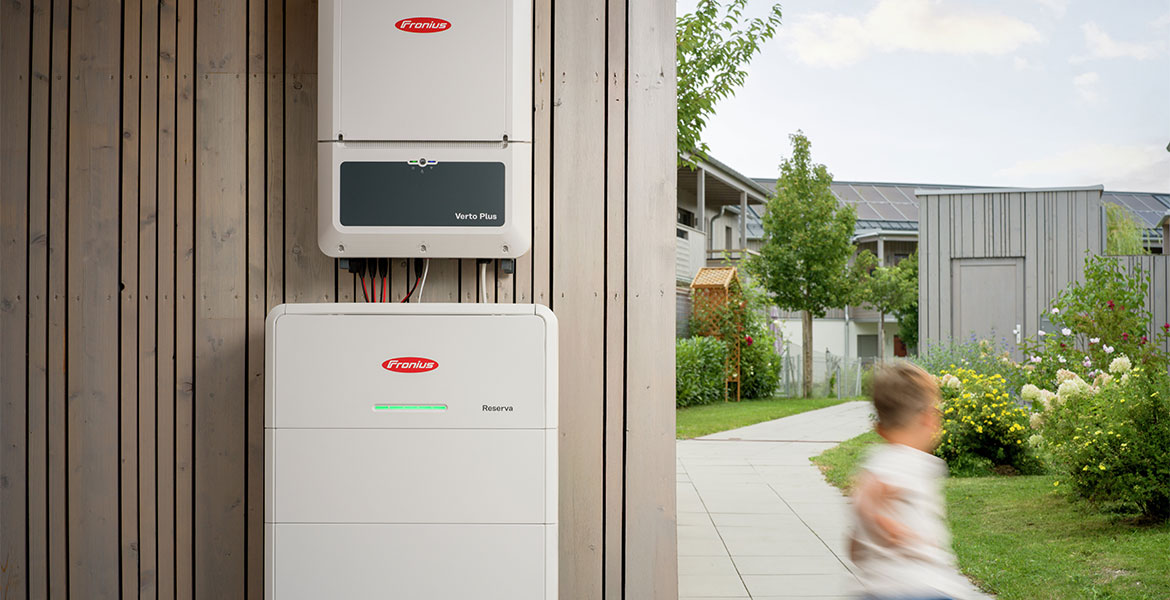
DC-coupled energy storage devices are located in the circuit upstream of the PV inverter and can be charged with solar power directly from the roof. In conjunction with a compatible hybrid inverter, they enable comprehensive system monitoring and many also come with an emergency power function (meaning they can supply the household with surplus PV energy in Full Backup mode in the event of a power outage). Some are even black-start capable. Find out exactly what is meant by “Full Backup” and “black-start capability” in this blog post.
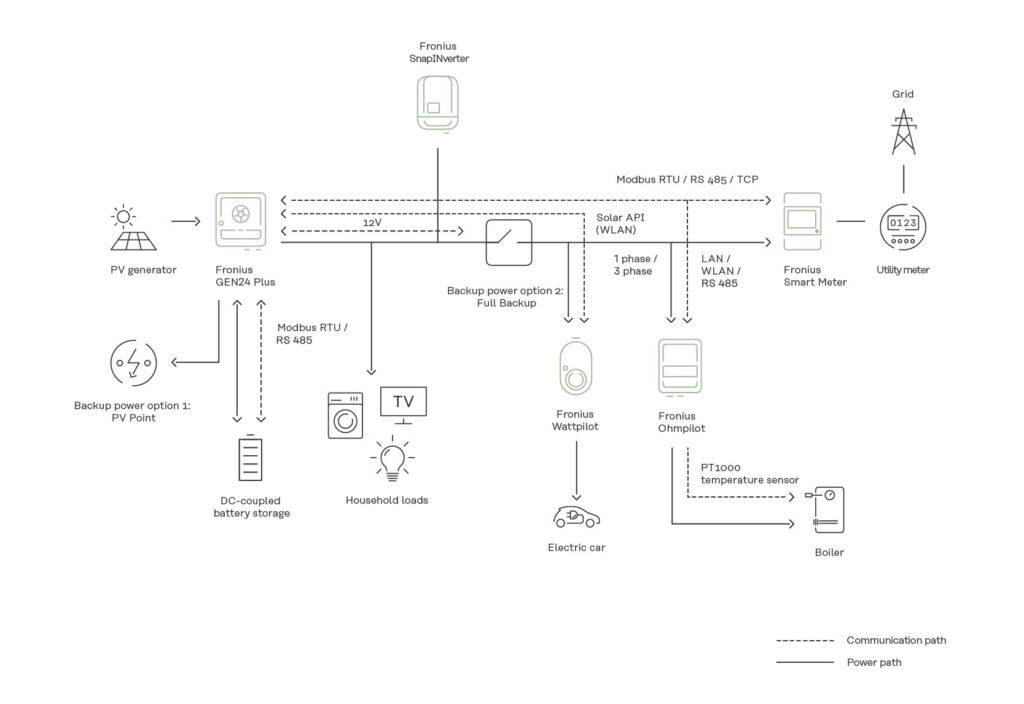
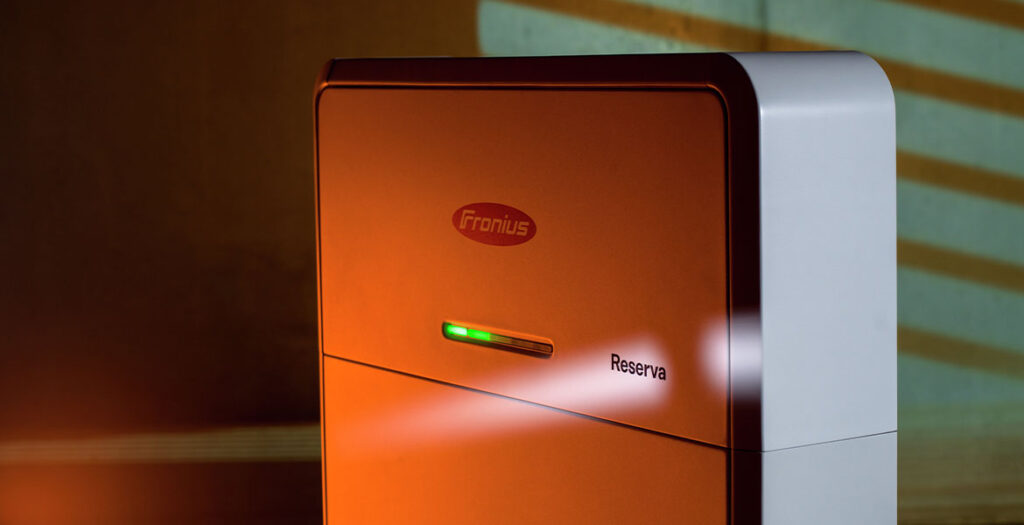
“PV storage devices of this type communicate best with a hybrid inverter and optimize self-consumption. One example of a DC-coupled storage solution is our Fronius Reserva,” says solar expert Schett. Incidentally, the Fronius Reserva comes with further benefits such as a ten-year performance guarantee, the black-start capability mentioned above, and European data security. Fronius inverters are also compatible with a range of partner batteries.
AC energy storage devices
AC-coupled energy storage devices are connected downstream of the PV inverter on the AC side. This means that they have to convert the solar power from the household grid (which has already been converted into alternating current) back into direct current, as only DC energy can be used to charge the battery. Consequently, two conversions are necessary to store energy: from DC to AC in the PV inverter and then back again in the battery inverter. Around two percent of the PV surplus is lost with each conversion. In addition, AC-coupled storage devices do not offer Full Backup and are incompatible with monitoring software. The biggest advantage of AC coupling is that there is no need to replace the inverter in existing PV systems.
Upgrading to a hybrid inverter
If you would like to retrofit an energy storage device but your PV system doesn’t have a battery-compatible inverter, there are two options.
One is to opt for an AC-coupled storage device as described above.
Alternatively, owners of an existing Fronius GEN24 inverter can simply upgrade its software. Fronius UP.storage is a software upgrade for GEN24 models that transforms your inverter into a Fronius GEN24 Plus hybrid inverter in no time at all. As Maximilian Schett explains: “This eliminates the need to replace the inverter, which saves costs and resources. Fronius UP.storage is available in our Fronius Solar.web monitoring tool.”
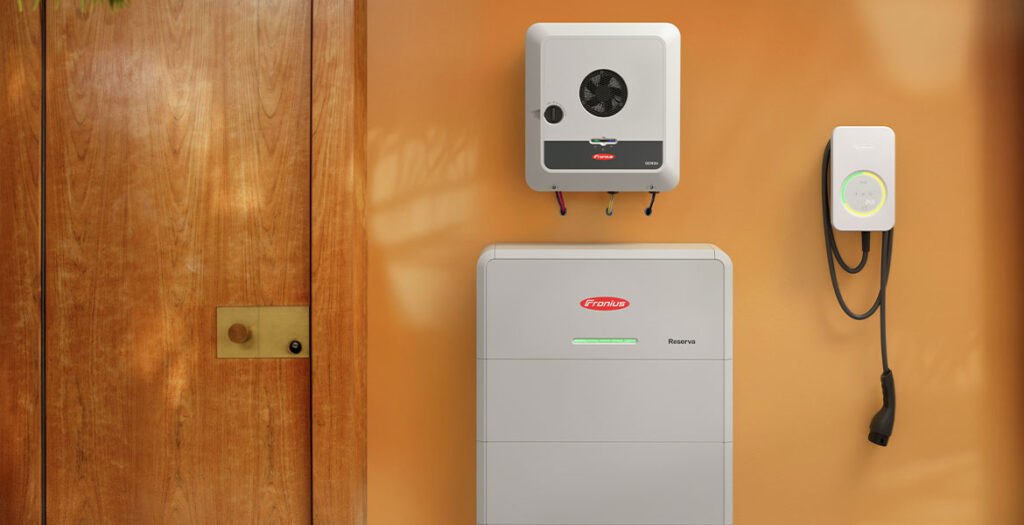
Are you interested in Fronius UP.storage? Further information is available in the Solar.web store and from your installer.
Summary
Energy storage devices increase your self-consumption rate and degree of self-sufficiency, but always require a significant financial investment. This is precisely why it’s so important to make sure that you get the battery capacity right from the outset. You can calculate what size of battery is right for you based on your annual energy consumption and individual load behavior so that sufficient storage capacity is ultimately available for your household and the PV system.
System owners can achieve optimum self-consumption with an adequately dimensioned DC-coupled storage system working in combination with a compatible hybrid inverter. Newly installed PV systems thus achieve a high level of efficiency and a self-consumption rate of approximately 60%. One example of a suitable storage solution is the Fronius Reserva.
If you would like to retrofit an energy storage device without a hybrid inverter, an AC-coupled solution will work with any inverter, but you will lose out on monitoring and Full Backup functions.