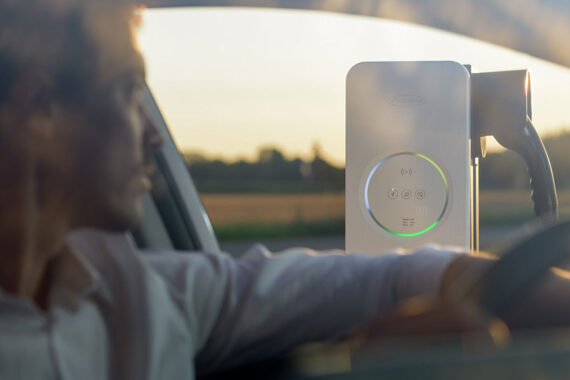
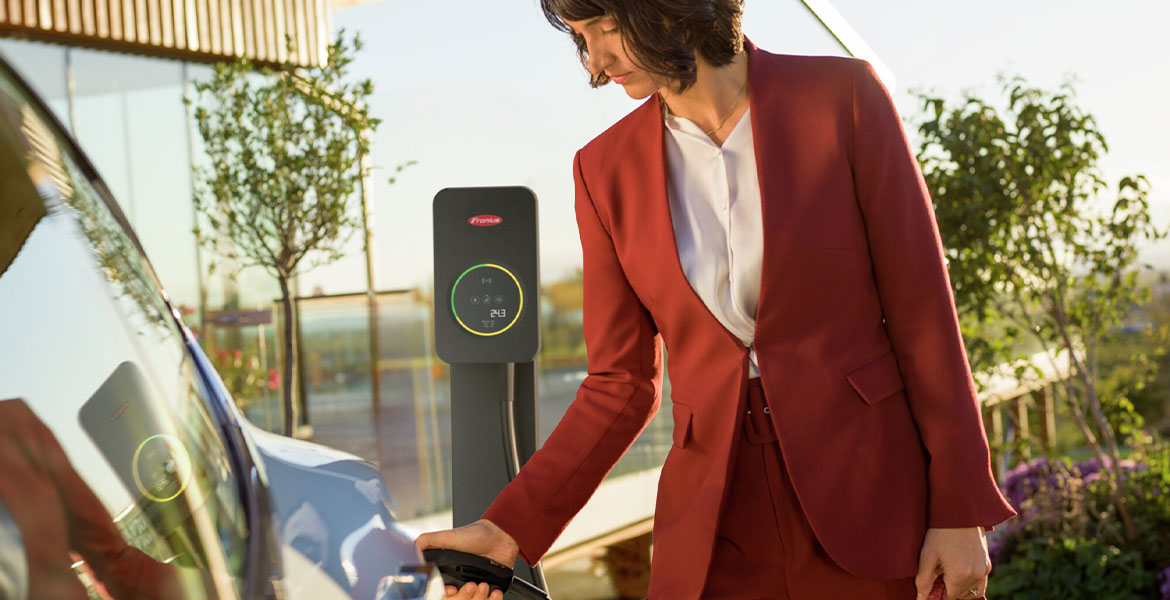
Charging an EV at home has become one of the most practical questions for company car drivers: How do I charge my company car at home? Who is responsible for the energy costs, how are they billed correctly, and what technology is involved? Markus Brandstötter, a product manager for e-mobility at Fronius, explains in an interview how it works in practice—and what role AI and bidirectional charging will play in the future.
What do I need to charge my company EV at home and then bill my employer for it?
The most important thing is a MID-compatible charging station. MID stands for the Measuring Instruments Directive of the EU. As soon as you want to bill for electricity—for example, tenants or your employer—the metering must be MID-compliant, similar to a heat meter or a water meter. In Germany, and soon in Austria as well, the Measurement and Calibration Law (Mess- und Eichrecht) also applies. A MID reading is sufficient if only the company car is being charged. However, if I also charge a private vehicle and therefore charge several electric cars at the same charging station, then this must comply with the Measurement and Calibration Law.

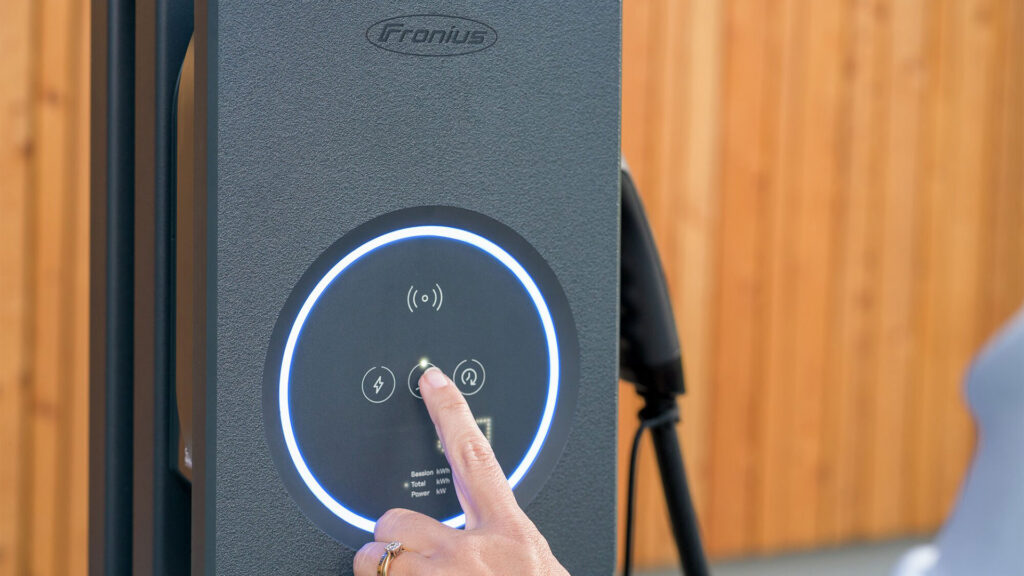
Above all, it is important to assign charging sessions to the respective user or vehicle. This is done using a so-called RFID reader (editor’s note: Radio Frequency Identification). It detects ID chips from a short distance via contactless radio transmission and reads the information stored on them. The Fronius Wattpilot charging stations come with a built-in RFID reader. Two ID chips are also included in the scope of supply. However, these ISO/IEC 14443-compatible ID chips are also built into many bank cards and can be programmed into the Wattpilot, so you don’t need to carry an additional ID chip with you. Charging is only enabled and the charging station unlocked, so to speak, when the corresponding chip is presented. A data record is automatically saved for each charging session.
A MID-compliant charging station is required to charge a company electric car at home
How does data transfer from the charging station to the billing system work?
There are basically two options. The simpler one: from an app—with Fronius, for example, the Solar.wattpilot app—you can download the charging data as a CSV file. Once filtered by time period or vehicle, the data can then be used for billing purposes. This is a practical solution, especially for smaller businesses with few employees or when the company fleet is still being built up.
The second option is to use a mobility service provider, which communicates with the charging solution via the OCPP 1.6 interface. (Editor’s note: the Open Charge Point Protocol (OCPP) is an open communication standard between charging stations and billing systems that enables charging sessions to be authenticated, initiated, controlled, and stopped.)
The provider authenticates itself using RFID tokens; authorization is granted by the mobility service provider—and the data is stored there centrally. The process for transmitting data to the employer varies depending on the provider. It can be transferred as a PDF or Excel file. Some systems are also directly integrated into payroll processing—such as our Fronius EMIL software solution. It is usually the employer who decides which system is used for the company fleet.
What do I need to keep in mind while charging my company EV and my own car using the same charging station?
Of course, I can charge both cars with one charging station; with the different ID chips, that’s no problem at all. A simple solution is to keep the home charging station unlocked at all times for the private vehicle, which is usually the case for charging stations intended solely for private use. This only requires an ID chip when a company car is being charged and the cost needs to be billed.
And how does it work when multiple electric cars are being charged at the same time in a household?
In general, I have to keep an eye on the total load in the house, especially when I want to charge two cars at the same time. An electric car typically charges at 16 amperes. If two charging stations are operated in parallel, a total of 32 amperes must be supplied. This can overload the post-meter fuse—that is, the main fuse located after the electricity meter. In our part of the world, this is rated at 25 to 35 amperes; in Germany, it is approximately 63 amperes and in Finland often only 16. It trips as soon as the set maximum value is exceeded.
To prevent a power outage in the home, reliable load management is therefore essential. This allows the charging station to monitor power consumption and automatically reduce the charging power as soon as the total load becomes too high, ensuring that you always stay below the limit value.
Modern charging stations such as the Fronius Wattpilot feature built-in Dynamic Load Balancing: the individual phases are monitored via a Smart Meter. As soon as one phase draws too much current, the system dynamically reduces the load so that the fuse does not trip, while still utilizing the maximum possible charging power. With the Wattpilot, the maximum permitted current can be easily set using the Solar.Wattpilot app. The system is then managed via a server, which in turn allows for an unlimited number of Wattpilots.
For larger electric vehicle fleets, user-based prioritization is also possible using Fronius EMIL. After all, not every car is always parked in the same spot at the company. In addition, individual employees can be allocated a higher charging capacity if they need to return to the field quickly. EMIL offers many additional features in this regard, specifically designed for business solutions.
What technological trends will shape charging EVs in the coming years?

The trend toward e-mobility is clearly continuing. In some households, an electric car is designated as the secondary vehicle. So many people have already had positive experiences with it and know that e-mobility really does work in everyday life. In practice, internal combustion engines are now gradually taking a back seat because they are simply more expensive to run. Especially if you have a photovoltaic system at home, an electric car is definitely worth the investment.
For many families, electric cars are already the more affordable alternative to gasoline-powered vehicles
Former skeptics are gradually being won over by longer ranges, improved charging infrastructure, experiences with battery longevity, or even by friends who already drive electric vehicles. Initial skepticism is giving way to a newfound maturity of experience.
The 800-volt technology, which was previously reserved for the luxury segment, is gradually finding its way into the standard range—with realistic charging capacities of 200 kW upwards. 100 km in less than 5 minutes is already commonplace here. Work is underway on a new cell chemistry for the next generation of car batteries with the aim of reducing charging times from the current 30 minutes to about ten minutes.
Wireless charging is also a recurring theme: while it would certainly be very handy, due to lower efficiency, acquisition costs, standardization, and vehicle positioning, it will not yet play a significant role in e-mobility in the medium term in my opinion. Of course, a lot could still happen in this area over the next five to ten years.
What role will AI play in the EV charging process in the future?
For me, the charging process is part of an energy management system and therefore fits into the broader framework of PV generation, storage, household consumption, and other controlled loads. The more factors that need to be controlled and the more conditions—such as maximum feed-in limits or flexible feed-in and consumption tariffs—that need to be taken into account during optimization, the more AI makes sense. The challenge here is ensuring that these optimizations are traceable; features of the Wattpilot, such as “Next Trip” Mode, which uses the most cost-effective charging window of flexible tariffs and free PV electricity until the next trip—or ECO Mode, which uses only surplus PV power or only low-cost power from the grid, are implemented in a conventional manner. On the other hand, the ECA (editor’s note ECA = Fronius Energy Cost Assistant), which optimizes the storage strategy of the home battery storage based on weather, yield, and consumption forecasts, is already based on AI. There are still many ideas and possibilities for the ECA.
And what is the current status of bidirectional charging? That’s a term you hear more and more often.
Bidirectional charging is a particularly exciting topic. It means that electricity can flow both to the electric car’s battery and from it—into the home, the grid, or other devices. The range of use cases is equally diverse. A simple example: You can also charge power tools while on the go using a socket in your car. This allows a tradesperson to charge their cordless tools directly on the job site. In principle, this is nothing new and vehicle-to-load, i.e., the transfer of electricity directly from the car to external devices, has been possible for some time.
However, bidirectional charging becomes challenging when it is grid connected, meaning the electric vehicle is connected to the grid. This allows the vehicle to be used as a household energy storage device, usually to supplement the stationary battery in a smaller home storage system.
Does that mean I’ll have more stored energy available in the event of a power outage?
That’s right; backup power mode is an excellent use case because a full vehicle battery provides 50 to 70 kilowatt hours of backup power instead of the usual 10 or 20 kilowatt hours of a stationary battery. This ensures that a household can be adequately supplied with power for some time in the event of a grid outage.
Another use case is vehicle to grid, meaning the car acts as a power source and feeds electricity into the public grid. This requires the right incentives: variable electricity prices make it possible for an electric vehicle to be charged using inexpensive solar power and then feed electricity back into the grid when prices are high.

If all of this is already technically feasible, why isn’t bidirectional charging more widespread yet?
There are already some proprietary solutions on the market—that is, technical solutions from a single manufacturer that are not openly accessible or standardized. For example, there are car manufacturers that already offer bidirectional charging stations compatible with certain car models. However, these only work in combination with the corresponding car model. So if I ever want to change my car, this solution will no longer work.
What exactly is the reason for that?
Well, the technical basis for bidirectional charging is the ISO standard ISO 15118. This defines the communication interface between the electric vehicle and the charging station—in other words, the common language that both sides must speak. While ISO 15118-2 laid the groundwork for smart AC and DC charging, ISO 15118-20 introduces significant enhancements, including bidirectional charging capabilities (V2X) and improved security and authentication mechanisms. This is precisely what is essential for bidirectional charging, because without a common, standardized communication protocol, the vehicle and the charging station cannot exchange energy in a coordinated manner. Interoperable, i.e., manufacturer-independent, V2G solutions remain a dream of the future.
What conditions are necessary for this?
There are several. You need a charger that can both charge and discharge in all cases. In widely used AC charging stations such as the Fronius Wattpilot Flex, the charging electronics—known as the onboard charger (OBC)—are located in the car, which means the vehicle must also support bidirectional charging at the hardware level. That makes the whole thing very complex.
With DC charging stations, on the other hand, the power electronics are located outside the vehicle, and the connection is essentially made directly to the car battery. All grid-related functions are handled not by the car, but by the charging station. While this does make it easier to implement bidirectional communication, the device is also correspondingly larger. Both the vehicle and the charging station must support ISO 15118-20. The Alternative Fuels Infrastructure Regulation (AFIR) requires this for charging stations in Europe from January 1, 2027; however, there are very few electric vehicles that already comply with ISO 15118-20. The Wattpilot Flex already has the necessary hardware built in and will release the software as an update in due course.
In addition, some car manufacturers impose restrictions on discharging. Warranties and liability terms are subject to change, or the maximum discharge capacity is limited, meaning that applications can only be used for approximately two years, after which discharging is automatically disabled.
The EU RfG 2.0 Regulation (Requirements for Generators) makes islanding detection mandatory. This monitors the grid and interrupts the feed-in in the event of a grid failure for safety reasons. In Germany, according to VDE-AR-N 4105, the islanding detection must be built into the charging station and therefore must not be located in the vehicle. For AC charging stations, this is technically challenging to implement.
Not all norms and standards are currently fully defined, and individual countries may impose further restrictions. Once these conditions are in place, the next challenge is to test different vehicles with different charging stations. In practice, however, there is always room for interpretation even in supposedly standardized communication. I like to compare this to different dialects, which can lead to misunderstandings in communication even though they are part of the same language.
Is there a trend here as to which type of charging station will become the standard for bidirectional charging?
In fact, this has been a point of contention for years, and, to be honest, it’s still unclear whether AC or DC charging will prevail. But one thing is clear: work is proceeding at pace on both solutions, including at Fronius.
Conclusion
Charging company electric vehicles at home is no longer a technical challenge, provided that the necessary factors are taken into account: legally compliant charging stations, clearly assignable user profiles, and digital billing options offer transparency for employees and companies. Thanks to AI-based energy management systems that take into account factors such as expected PV yields and electricity prices, the charging process is becoming increasingly economical.
With bidirectional charging, the electric car is evolving from a mere consumer of electricity into a flexible energy storage device for the home, a backup power source, or even a means of feeding electricity back into the grid. To fully realize this potential, in addition to technical standards, binding regulatory conditions are needed, which are currently being developed across Europe.