When welding with shielding gas, the gas shield is more than just a technical aid. It is a decisive factor in the quality of the weld, the efficiency of the process, and the sustainability of the entire production setup. How much shielding gas is actually needed? How can consumption be controlled intelligently and in a way that conserves resources? In this blog post, we shine a light on the role of shielding gas. We explain the risks of an incorrect gas flow and show how modern technologies—such as intelligent gas regulators—can cut gas usage by up to 40%.
How to adjust shielding gas to avoid waste and defects
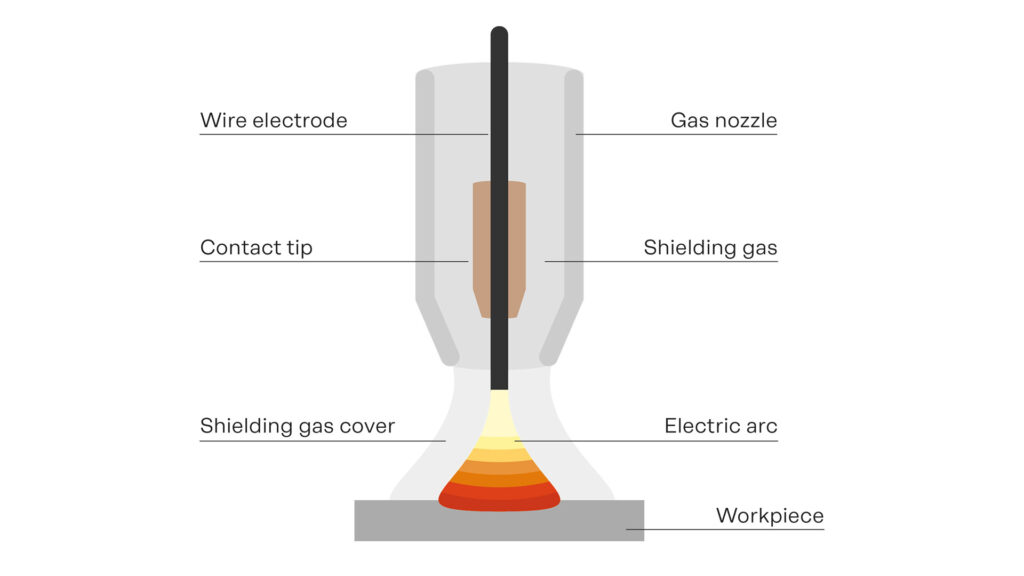
In arc welding, the protective gas shield protects both the arc and the weld pool from the surrounding atmosphere. Without this protection, oxygen, nitrogen, and other components in the ambient air would react with the liquid metal, causing porosity, oxidation, spatter, and an unstable arc. A precisely metered gas flow is therefore essential for a high-quality welding result.
A stable gas shield is the goal, but establishing it is not always easy. Too little gas means insufficient protection, while too much gas generates turbulence that allows ambient air to reach the weld. Both impair the seam quality and increase reject rates or the amount of rework required. At the same time, the shielding gas itself is a valuable resource. Not only is it a cost, but so much energy is needed to produce it that it has a correspondingly high carbon footprint. Using shielding gas responsibly is therefore both a financial and an environmental necessity.
How saving shielding gas improves competitiveness and efficiency
Reducing shielding gas consumption without compromising weld quality is a win-win situation. Optimal gas metering is not only a cost factor and a contribution to environmental protection, but also a clear competitive advantage. When companies cleverly reduce their gas consumption, they also reduce their carbon footprint. This can improve their position in tenders, fulfill regulatory requirements, and strengthen their image as a sustainable manufacturer.
Three main advantages:
- Cost reduction: Shielding gas is expensive. Every liter saved reduces operating costs.
- Process reliability: Precise gas control improves the reproducibility and quality of the welds, reducing both rejects and rework.
- Sustainability: Less gas consumption in production means a lower gas-induced carbon footprint.
Impact of shielding gas on the carbon footprint per meter welded
The debate on sustainability is often very emotional. At Fronius, however, we rely on facts rather than feelings. In our comprehensive, externally certified Life Cycle Assessment (LCA), we consider the total life cycle of a welding machine, including its use by the customer. Our LCA shows that shielding gas has a significant impact on the overall carbon footprint. By converting the LCA results to one meter of weld seam, we can see that shielding gas is the second largest factor influencing the CO2 balance in the robot-supported customer applications examined.
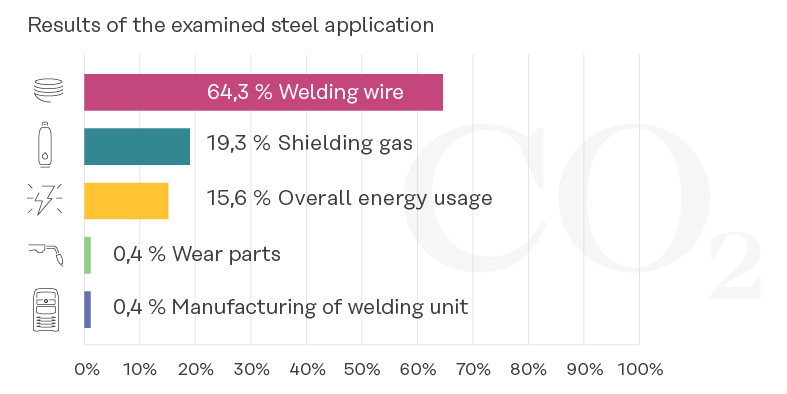
The good news: Innovative technologies and optimized welding processes—like those possible with modern, intelligent welding systems—can significantly reduce gas consumption. Let’s look at this in a little more detail:
How to avoid excess gas when starting welding
Classic gas control via solenoid valves has one major disadvantage: when welding starts, a so-called “blow-out” occurs—a brief excess of gas that escapes unused. Each time the arc is ignited, the gas flow increases to a multiple of the quantity actually required (and set on the machine). Over time this effect adds up to a lot of unnecessary gas consumption, especially with frequent short seams or stitch welds.
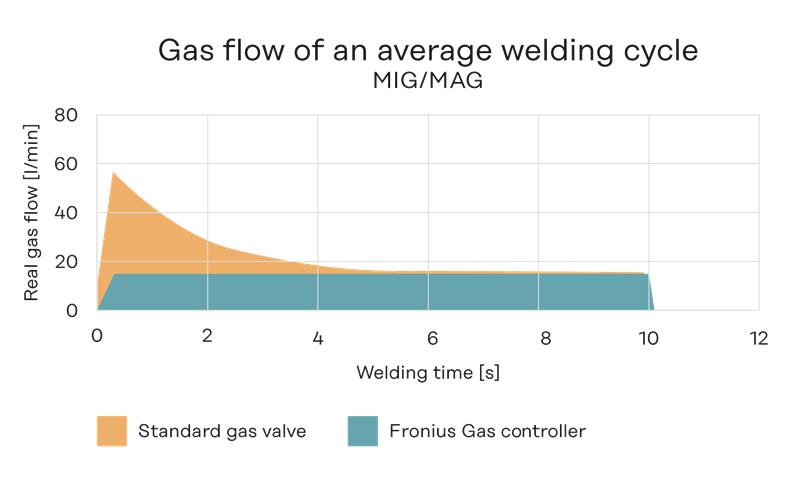
This graph clearly shows how the gas flow increases sharply for a short time at the start of welding and only then returns to the actual set flow rate. The intelligent Fronius gas regulator is different. It reliably welds with the set quantity right from the start.
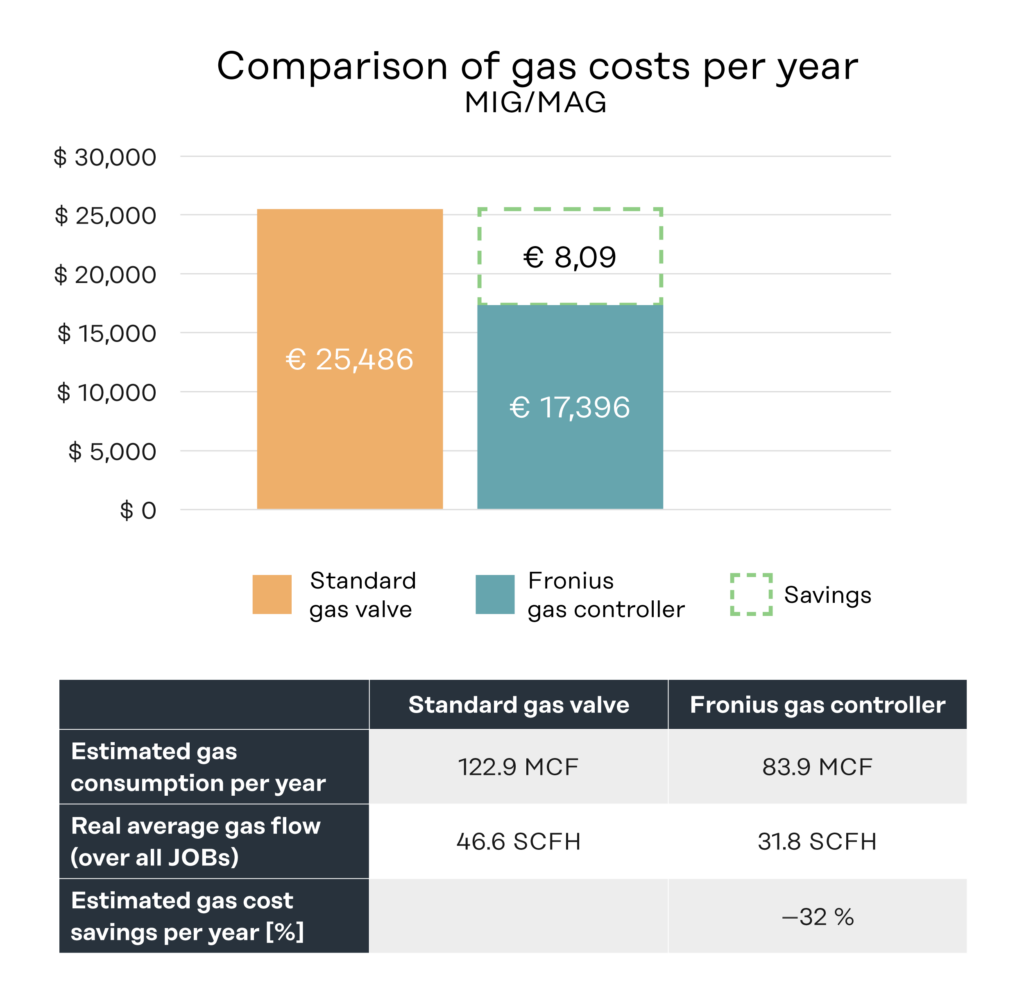
Example calculation: For a steel application: TPS/i, MIG/MAG dip transfer arc, 82% Ar/18 CO2, 1 m weld with 10 seams of 10 cm each, fillet weld, seam cross-section 9 mm, plate thickness 3–4 mm
Adaptive shielding gas control for reduced consumption
Standard gas solenoid valves switch the set gas flow on and off after the pressure reducing valve. Only one value can be set for the flow rate per component. In practice, this means that the gas flow rate for the entire component is determined by whichever seam requires the highest gas flow.
If, for example, 15 different seams need to be welded on one component and just one of these is in a constrained position, then this one difficult seam decides the minimum flow rate for all other seams—even if the remaining 14 could be welded with much less gas. To prevent this wastage, you should opt for high-tech welding machines that either allow you to set a different gas flow per welding job or that regulate the gas flow depending on the power output.
Fronius intelligent gas regulator: Dynamic control to reduce consumption
With the intelligent gas regulator, Fronius has developed a technology that addresses the problem of unnecessary gas wastage:
- Avoid blow-outs: The gas regulator smoothens the gas flow during start-up and prevents unnecessary losses.
- Power-dependent control: The gas flow is dynamically adapted to the welding power.
- Job-specific metering: The optimum amount of gas can be defined individually for each weld seam.
The result is up to 40% less gas consumption with consistently high welding quality.
Quick integration with immediate efficiency gains
Another advantage is that the intelligent gas regulator can be installed in a few simple steps on all Fronius TPS/i and iWave welding systems. At Fronius we also offer individual advice and calculations on potential savings in your own business.
Conclusion: Shielding gas optimization for efficiency, savings and lower CO₂
The right amount of shielding gas at the right time is the key to efficient, sustainable, and high-quality welding. The intelligent gas regulator from Fronius achieves this balancing act effortlessly. Companies benefit from lower costs, better seam quality, and a smaller ecological footprint. In other words, nothing but upsides across the board.
Want to find out more?
Let the Fronius experts advise you and discover just how much you could save: