

Power market insiders will already be familiar with terms like spot market, merit order, power exchange, and feed-in limits, to list just a few. But for many others, they might just sound like industry jargon. Knowing these terms isn’t really essential, though—what really matters is using the market’s nuances to your advantage. Which is where tools like the Energy Cost Assistant (ECA) from Fronius come in. We explain how it works, the strategies you need to navigate the jungle of power market pricing—and how to come out a winner.
What determines prices in the electricity market?
In our part of the world, electricity is constantly available to just about everyone. This relies on there being a balance between electricity generation and consumption, and electricity providers are responsible for purchasing the necessary amounts on the market.
A large share of this energy is covered by long-term contracts, or futures. But because these assumptions can never be 100% accurate, the remaining demand has to be met through short-term supply on a day-ahead basis. Known as the spot market segment on the power market, this is where electricity prices for the following day are sold in hourly batches.
The price per kilowatt-hour (kWh) is determined by the demand for electricity and the power plants that need to be brought online to meet that demand. Renewable energy sources, such as solar, wind, and hydroelectric power are prioritized in the electricity mix, with coal- or gas-fired power plants being brought online only when these resources are insufficient.
The total price per kWh is determined by the power plant with the highest marginal (variable) costs—i.e., those required for cost-effective operation. Here’s what this means in practice: Consider a weekday evening when electricity demand is high but solar and wind output is low; in this case, thermal power plants (gas and coal) must be brought online to meet the shortfall. Each kWh therefore costs a specific amount, which is set during the previous day’s auction. This amount is paid to all suppliers who are providing electricity at that time—including those whose marginal costs are below the given amount. As a result, one kWh of renewable electricity costs the end-user household the same as electricity from a fossil-fuel power plant, even though it would normally be significantly more expensive. This is precisely how merit order works.
How do the spot market and flexible electricity rates work?
For many years, this system only really mattered to electricity traders, because end customers typically had fixed-price rates per kWh consumed. But another approach that has been growing in popularity for some time consists of variable, market-based electricity rates. These pass along the price set at the day-ahead auction (typically with small markups), making power market prices an attractive proposition for individuals as well.
In fact, when an oversupply of renewable energy coincides with reduced demand (usually on weekends), the price can even drop below zero. Which means that consumers end up being paid for purchasing electricity. But it’s important to note that this only applies to the price per kWh—the grid fees still need to be paid, so a negative electricity price does not automatically result in you being credited on your bill.
Cutting electricity costs through automated energy management
As an end user, making effective use of flexible electricity rates might appear to involve a fair amount of detailed knowledge at first—but it definitely doesn’t make much sense to manually turn household appliances on and off based on the current price per kWh. Automation is the key to success here. This approach now has a proven track record when it comes to charging electric vehicles, with a great example being the Fronius Wattpilot. This solution not only uses surplus PV to charge your car but also automatically responds to low prices on the spot market.
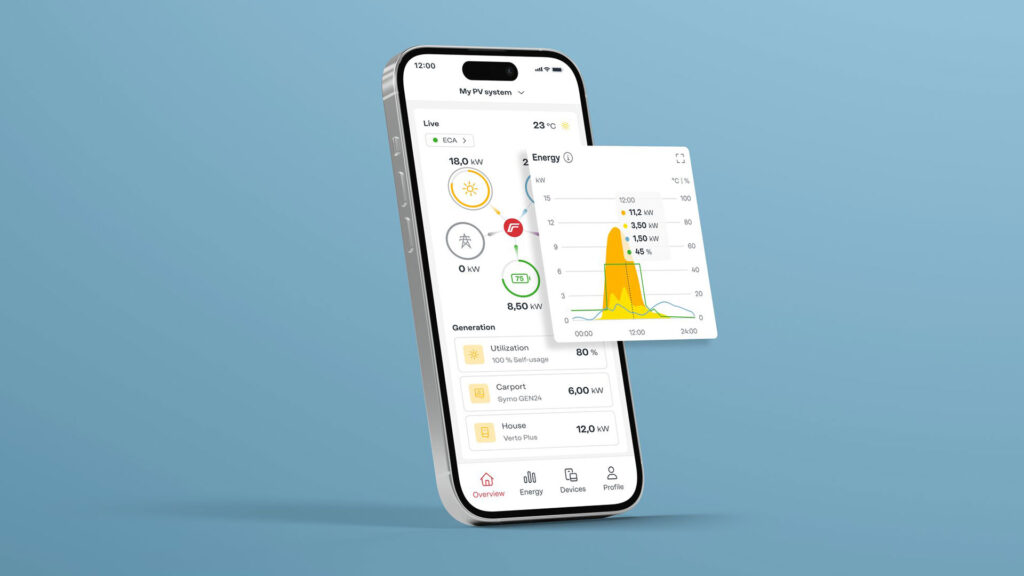
Those who own photovoltaic systems with battery storage can now take advantage of this same approach in their own homes without the need for expensive home automation systems. The Energy Cost Assistant (ECA) from Fronius ensures optimal management of the energy storage device and maximizes self-consumption. You’ll need a photovoltaic system with Fronius components and a Solar.web Premium account to use it.
How the Fronius Energy Cost Assistant helps you save on electricity
The Energy Cost Assistant uses AI technology to analyze the expected PV yield, the current electricity price, and the household’s energy needs. Based on this, it determines the optimal storage strategy. In certain cases, this may well mean that it is more cost-effective to draw power from the grid and feed surplus PV back in.
Likewise, it’s possible to limit battery discharge when prices are low so that the energy kept back can be used when the rate rises again. The Energy Cost Assistant organizes all of this while always taking battery health into account, which also rules out a reduced battery life.
Of course, the actual savings for end users will vary depending on their individual circumstances and usage habits. On average, however, you can expect to save up to 14.7% on electricity costs.
Feed-in limits and peak shaving: how to maximize your PV surplus
As PV capacity expands, feed-in limits (also known as peak shaving) are becoming another increasingly important factor. The goal here is to prevent grids from becoming overloaded when there is too much (renewable) energy available. Regulations vary from one place to another, but they all have one thing in common: if the amount of electricity fed into the grid is limited to a certain level, any solar power exceeding that limit is lost unless it is consumed by the user.
This is where the Energy Cost Assistant comes in. If the weather forecast predicts high levels of PV generation around noon, for example, the system reserves battery capacity ahead of time. This prevents energy generated during periods of overproduction from being wasted if there is a feed-in limit. The advantages of this are twofold. Firstly, all of the solar power generated is put to good use, and secondly, the system also makes a valuable contribution to stabilizing the grid.

Getting started with ECA: setup and requirements
First off, activating the Energy Cost Assistant is quick and easy on existing systems equipped with Fronius components. You’ll need a GEN24 Plus or Verto Plus hybrid inverter as well as a Fronius Smart Meter and a compatible battery storage system. If you already have a Solar.web Premium account, there are zero additional costs.
Even with this simple setup, the system helps prevent feed-in limits or peak shaving. But to take full advantage of the ECA, you’ll also need a flexible electricity rate—i.e., one based on the market price. Many established energy suppliers now offer this type of service. It’s often worth comparing rates, because even though the price per kilowatt-hour itself is based on the spot market, there are often basic fees or surcharges of varying amounts.
- The ECA turns flexible electricity rates from stumbling blocks into stepping stones by giving you a complete overview of the current pricing situation on the spot market at all times.
- Feed-in limits are no issue, because the ECA precisely manages battery charging to minimize losses while also contributing to grid stability.
- You get the maximum yield from your own PV system, because the ECA manages the energy storage device for cost-effectiveness and battery health.
Making the electricity market work to your advantage
From rising energy costs and complex pricing to changes in the regulatory framework for photovoltaics, the energy market is so full of unique, complex factors that it’s often difficult to tell how it all works. But smart energy management systems like the Fronius Energy Cost Assistant prove that there’s a way through.
With the necessary know-how and the right tools at the ready, you can navigate the jungle of the energy market—and even enjoy leveraging all the ins and outs to your advantage.