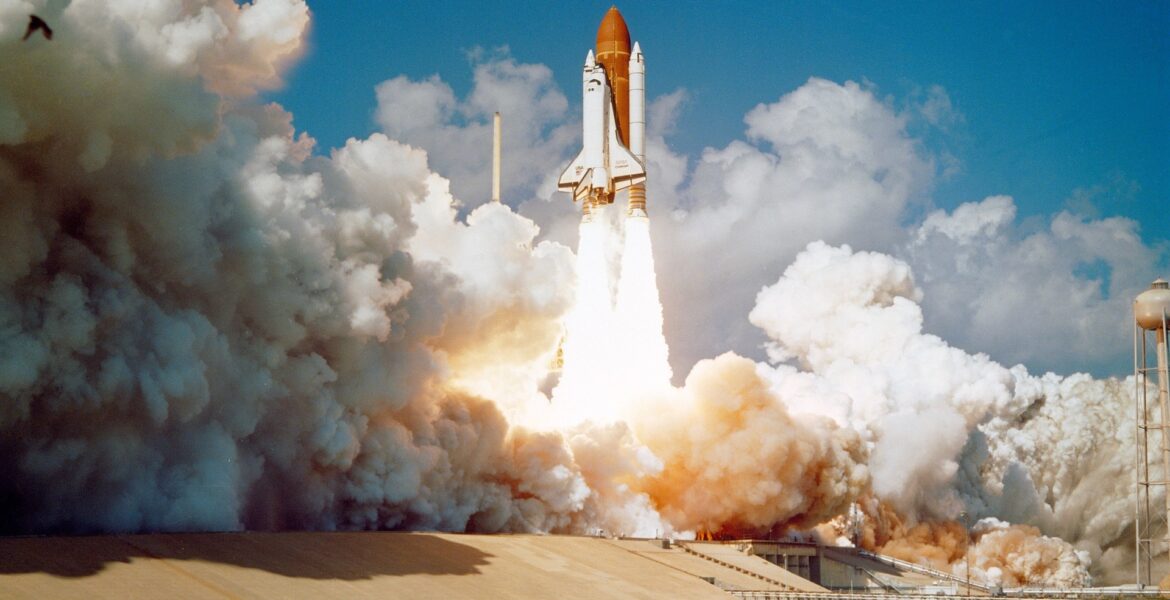
Space travel is undoubtedly the biggest adventure in the history of humankind. Satellites, space flights, and space stations head ever deeper into the endless expanse of the universe—all the while braving conditions that are unlike anything that can be found on Earth. In order to guarantee the safety of those onboard and the machinery, the quality requirements on manufacturing are exceptionally high, including the welding technology.
The challenges of the cosmos
Right from the beginning of their journey, spacecraft and satellites are subject to enormous strain. The initial acceleration can reach up to 4G, meaning that each part must withstand four times its own weight. The vibrations of the engines are also transmitted to the entire structure, which can cause damage. Once outside the Earth’s atmosphere, spacecraft enter a vacuum in which no air or pressure is present. Temperatures cannot be measured using conventional methods, but they can fluctuate by up to several hundred degrees Celsius.
In addition, there is always a risk of collision with other objects. Meteorites and an increasing amount of space debris from destroyed or discarded satellites and exploded rocket stages can all be found in the Earth’s orbit. These objects travel at such high speeds that even a collision with the smallest pieces can have serious consequences. All of these challenges are the reasons why organizations such as NASA and ESA, or private space travel companies such as SpaceX, have extremely high manufacturing quality requirements. This applies in particular to welding technology, which has a crucial role to play in space travel.
Special materials for special welding challenges
One thing is clear: only very special materials can be used for the arduous journey into space. Materials such as titanium, stainless steel, ceramic, and above all aluminum (and aluminum alloys) have proven to be particularly suitable. Just as in lightweight automotive construction, aluminum impresses with its low weight, high specific strength, and corrosion resistance. However, it is more difficult to weld than conventional steel—in part because of its low melting point and significantly higher thermal conductivity.
The right welding process for space travel
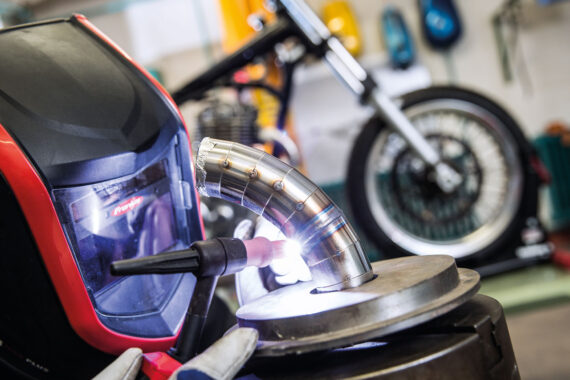
For a long time, Tungsten Inert Gas welding—better known as TIG welding—was the only process that could reliably meet the high demands of space travel. It is still successfully used in countless applications today. The TIG welding process creates particularly smooth, level, and non-porous welds that can withstand dynamic forces, making it a particularly good choice for root passes. You can read all about the other advantages that TIG welding has to offer in our blog article.
Other specialized welding processes are now being used for an increasing number of tasks in space travel. Plasma and friction stir welding are particularly common—both are ideal for creating aluminum joints and achieve a high weld seam quality, which is the basic requirement for stable spacecraft.
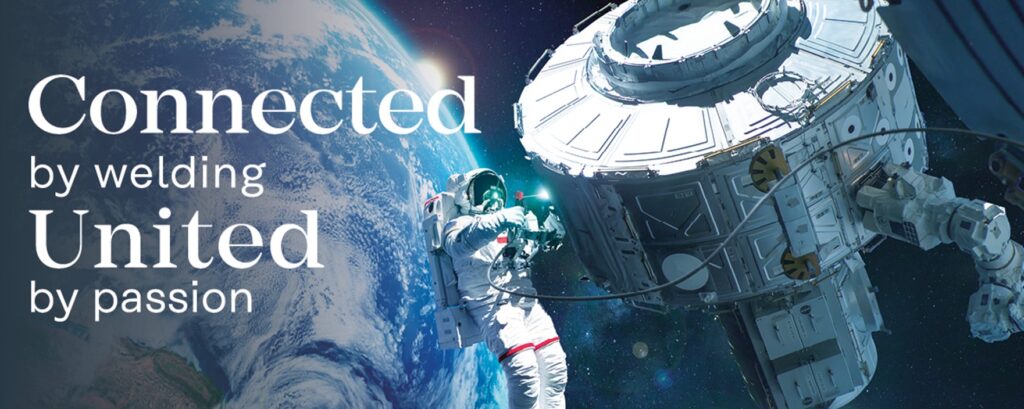
We wouldn’t be at all surprised if you’re now wondering whether you can even weld in space! The good news is that we have the answer.
Is it possible to weld in space?
To cut a long story short, yes, you can also weld in space—the first attempts were even made by astronauts as far back as the 1960s. But not all welding processes are equally well suited to the conditions in outer space. “MIG, MAG, and TIG have to be ruled out purely because of the vacuum, as the protective gas shield can’t be established in an absolute vacuum and in zero gravity,” explains Alfred Hartinger, a welding expert at Fronius International.
For this reason, laser welding—which doesn’t require any shielding gas—is being trialed in space. But there are potential challenges according to Hartinger: “A protective cell is required to prevent the laser from being refracted or reflected. Another problem is that thermal conduction is pretty much impossible in a vacuum. The high temperature fluctuations of several hundred degrees in space also make the welding process more difficult.”
Electron beam welding is another process that works in a vacuum. However, this is an expensive and maintenance-heavy technology so is not very widespread.
Another option for welding in zero gravity is friction welding, and in particular friction stir welding. This results in less material loss while producing strong welds.
It’s extremely rare for welding machines to be used in space, at least for the time being. Meanwhile, back on Earth, ever simpler and more reliable welding results of excellent quality can continue to be achieved.